Blog

  • AI Empowers Creativity and Creates Work

    AI Empowers Creativity and Creates Work

    Many are anxious about the rise of generative software marketed as “artificial intelligence”: software such as ChatGPT for text, Midjourney for images, Sora for video, and Suno for music. Some have raised concerns about a loss of truth and creativity, or about whole categories of gainful employment being decimated. To be sure, we’ve all seen our feeds populated by deceptive images and videos and lazy AI slop. There are bound to be many other harmful uses of generative software. Some jobs will be lost, others gained. Nevertheless, I’d like to make a case, from the perspective of a creator and graphic designer, that the anxiety about generative AI is largely unwarranted.

    Tools

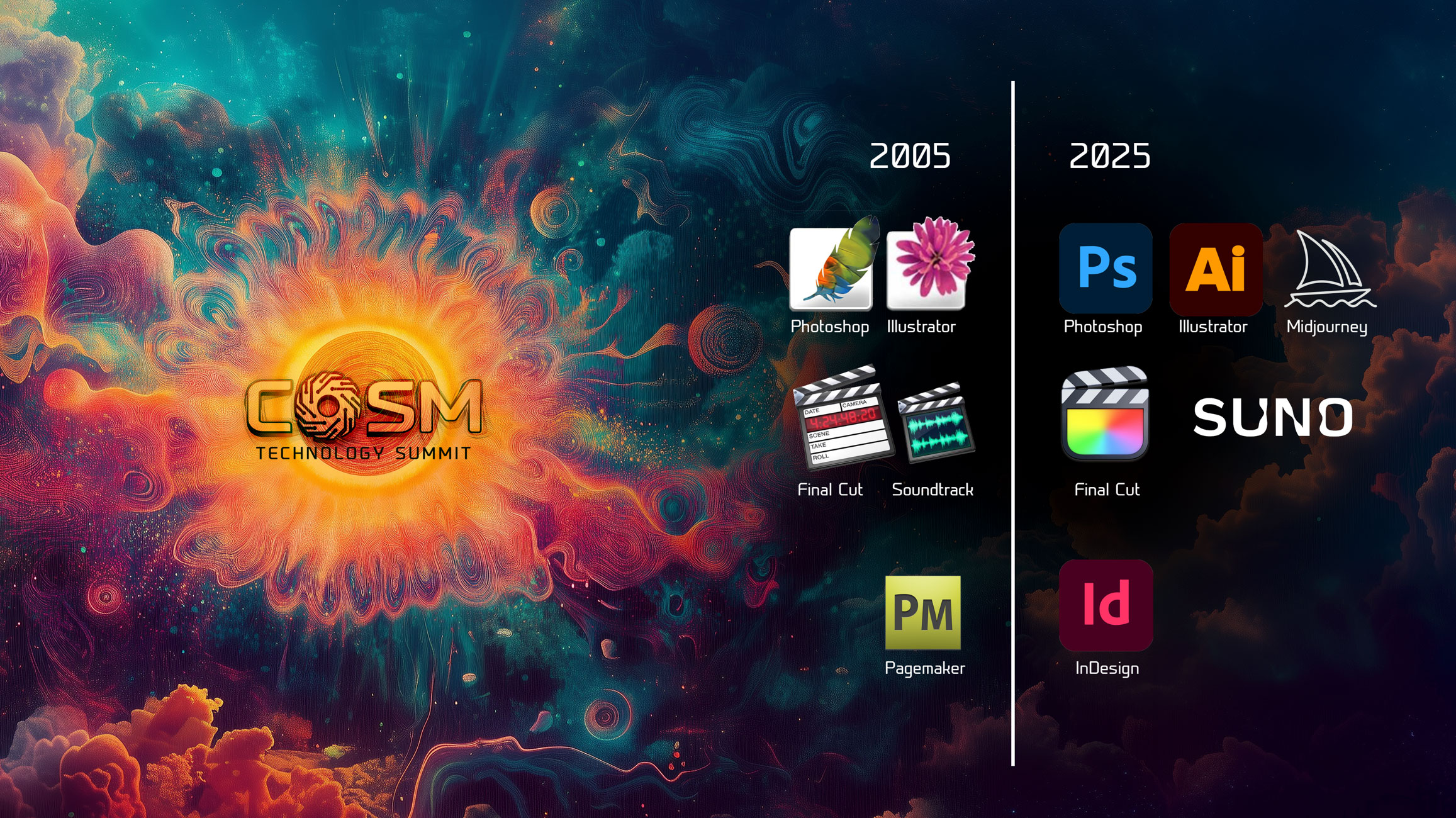
    To be human is to use tools. We have been inventing, sharpening, and depending on tools of all kinds as far back as we can trace. The ancients used sticks and stones and animal-hair brushes to paint the cave walls red. Today we use Photoshop and Illustrator to color the glass pixels on our screens. In 1990, I was screen printing t-shirts and stippling with pen and ink in art class when I first began doing page layout on the Macintosh LC using Aldus Pagemaker and scanned clip art — my first journey from analog to digital. A decade later, for my first short film, I used Photoshop, Illustrator, Final Cut Pro, Soundtrack, and low resolution GIFs and JPEGs scoured from the burgeoning internet. This year, for Discovery Institute’s COSM Technology Summit, I created the graphics and shorts using Photoshop, Illustrator, and Final Cut Pro, as before. Two relatively new generative AI tools joined the toolset: Midjourney provided the clips, and Suno the theme song.

    Working as a designer for over three decades, I am struck by the continuity of tools over time. I’m also reminded of how much work these tools eliminate from the creative process. Typesetting in InDesign requires the tiniest fraction of the labor needed for a letterpress. Kerning, leading, tracking, and variably sized type are a breeze and require no lead for spacing or chopped cherry trees for woodblock letters. Each software advance has facilitated new styles and greater efficiency while empowering me to do more than I ever could have with the previous toolset. Nevertheless, creating these moving images required hundreds of hours and thousands of ideas and decisions.

    In view of the long history of technologies that have facilitated the visual arts, what is the magnitude of change these latest tools represent? Is the development of generative software of the same gravity as the invention of the printing press, of the camera, of computer graphics? Or is it more akin to the introduction of layers in Photoshop or non-linear editing in filmmaking? When the camera was invented, depicting people and events became available at the click of a button. Artists understandably worried about the widespread availability of something only they had been able to do, with great training and effort. Art did change irrevocably. Digital photography and desktop printing ushered in further efficiencies, saving the hours spent smelling the vinegary acetic acid in the dark room. Now that my child can produce a neo-impressionist self-portrait or place themselves in a Himalayan scene with just a prompt, what does it portend for the creative arts?

    I reckon generative AI is more akin to a significant step forward for creatives than an earth shattering leap into a whole new world. Neural networks, machine learning, large language models, image segmentation algorithms, and generative diffusion are software innovations that are just the latest milestones on a long march of hardware breakthroughs and software algorithms.

    For example, ever since its debut, Photoshop has been filled with mathematical marvels that have enabled the tweaking and morphing of images. It’s hard for math mortals like myself to comprehend the calculations that are involved in inverting, cropping, filtering, and layering an image. These formulas have been hard-won by an enormous team of image processing engineers and mathematicians that have enabled digital artists to rearrange, blend, and stylize their work for decades. Indeed, filters like watercolor, fresco, and ink scratches appeared very early. And way back in 1996, Adobe introduced Actions in Photoshop 4.0, an automation tool that let users create a sequence of commands and play them back on other layers and images. These scripts enabled creators to more easily stylize their artworks as vintage, embossed, graffiti and a thousand other styles. A large third-party market of Actions developed and digital artists have relied on these recipes ever since.

    Ingredients

    Graphic designers and creators of all sorts have always relied on many ingredients and processes that they themselves did not create. Graphic designers use software, fonts, printers, and stock images, not to mention the design precedents of other artists that guide their work. For some projects I have created my own typefaces, sometimes I’ve created the source imagery myself, like spray painting graffiti onto cardstock for Free Science. I mixed thick coffee and wine and poured it onto a green screen to simulate blood for a film project. Some logos I’ve designed started as sketches with a pen or pencil. But even in such cases I rely on many ingredients and tools that I did not create. It’s like Leonard E. Read’s famous essay, “I, Pencil”. No one person knows how to make a pencil. The constitutive parts are sourced from a crowd of contributors, from lumberjacks, steelworkers, and graphite miners to machinists and importers.

    I think of generative AI as a vast new source of creative material, providing ingredients that I can use to make art. As with the parts of a pencil, software generated ingredients are a human product. Note well the literal definition of artificial: something made or produced by humans rather than occurring naturally. Everything about generative artificial intelligence is human in origin. The enormous data centers, the hydroelectric dams, the code innovations, the training data, the output evaluation, and the prompting all originate in a human mind endowed with creativity and reasoning. In the case of generative AI, that training data represents the sum of unfathomable hours of human creativity: petabytes of prose, poetry, painting, and song. So-called AI is not an accomplishment of machines or some emergent new intelligence. It is, rather, the extension of countless hours of human labor and logic. It is not a first cause nor a final cause. It is an efficient means for humans to create mashups of thousands of years of human creativity. Try as we might to endow our machines with their own vision, agency, and creativity, there’s no reason yet to think we can pass on these incredible gifts that we possess.

    It is humbling to remember how much we each depend upon the work of others to do our own work. It is also ennobling to remember with gratitude the unique gifts with which we are endowed. Granted, the extent to which a creator can call his or her art their own will depend upon how much of it is a product of their own work, versus how much is a product of the labor of others. A child who traces a giraffe and colors within the lines has added little. A cartoonist who only redraws Calvin & Hobbes or a memester who only adds a quip to characters generated in the style of Studio Ghibli adds little more. A graphic designer who uses stock imagery or fonts shares credit with the photographer or artist who created those elements.

    It is counter-intuitive, but using software generated images, videos, and sound allows the creator to put more of themselves into their work, not less. Depending upon stock images, clips, and tracks can be a very limiting and tiresome endeavor, often requiring hours of searching through stock providers for suitable source material. Being able to generate custom creative assets with a prompt enables the artist to shape their ingredients with the subject and style that is in keeping with their creative vision.

    Though it is now possible to generate a derivative piece of artwork with just a prompt, projects still require an idea, thoughtful prompts, and much in the way of curating and baking these ingredients into a whole.

    Stylization

    Every time I open Midjourney, it’s like visiting an art museum. The community gallery is full of the unexpected and introduces me to new styles and ideas. My own generations are a mix of my favorite styles: lithograph, risograph, Neo-impressionist, ink sketch, Norman Rockwell, etcetera. The art is of course wholly derived from the humans who created these styles in the first place, but it is nonetheless a joy to behold.

    One of the most empowering features of these generative systems is the ability to find and work within a style. For COSM I proposed the theme “vibe shift”. This initial idea got me thinking about “good vibrations”, and then about the sixties and seventies. We were headed to sunny Scottsdale, Arizona. So, a simple prompt came to mind: “disco, psychedelic sun”. This image below, generated by Midjourney, among many others, captivated me. It served as the seed for thousands of images to come — many unusable, but some pure gold.

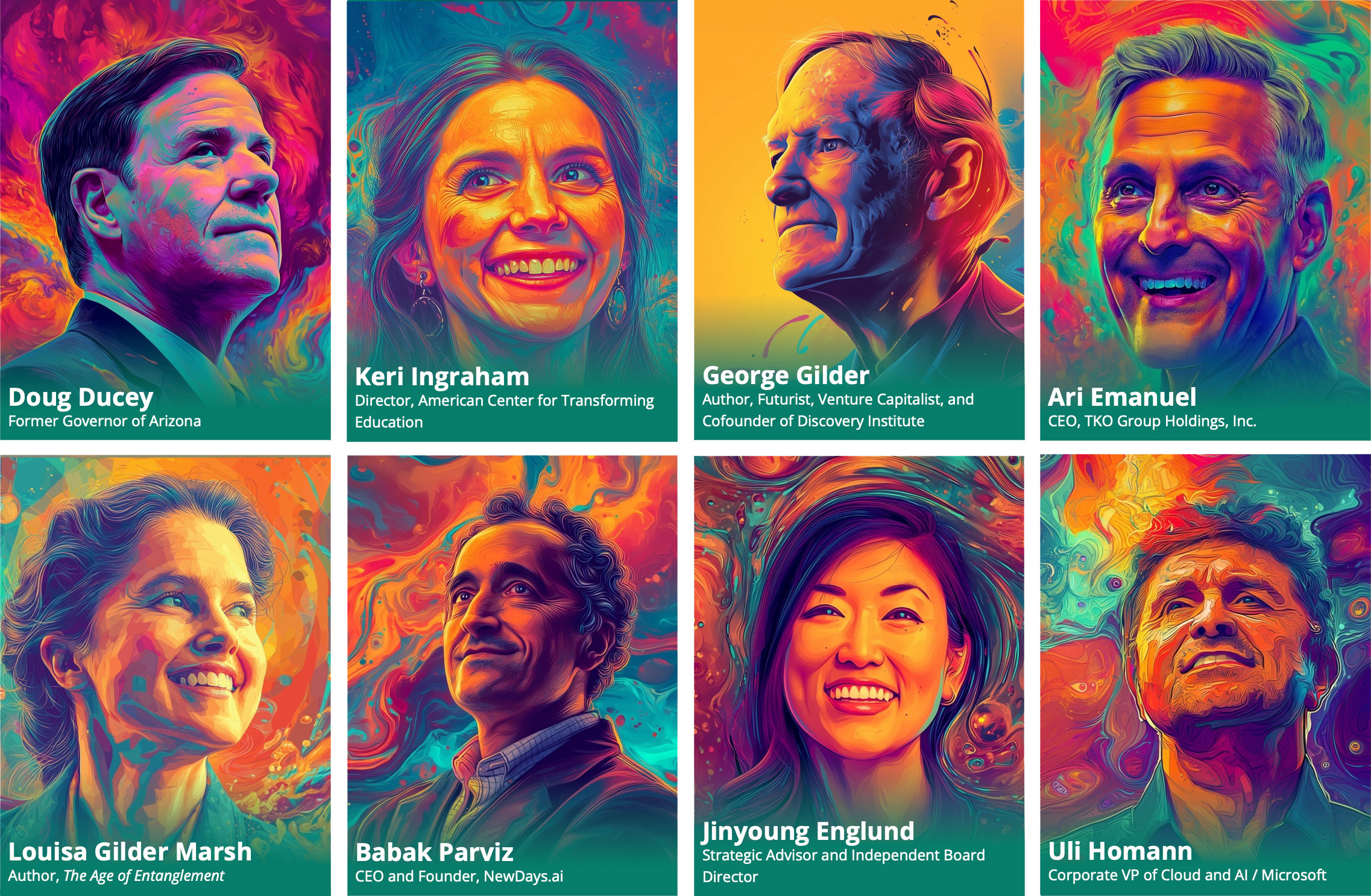
    Somewhere, many years ago, I had seen a liquid light show and the beautiful, organic shapes created by viscous oils and colorful liquids swishing around on top of an overhead projector. That provided the inspiration for a series of accompanying speaker profile images that were, well, groovy. Swirls of liquid colors frame their heads, the reference image lubricating the transfer of complementary colors.

    At each step there was a back and forth between the generative tool and my own ideas. Headshots have always been a challenge for designers. Speakers, board members, staff, fellows, and other participants — whoever they may be — submit a mess of images of varying quality, tone, and resolution. Short of flying everyone in for a photo shoot, an attractive and cohesive page of profile shots is elusive. I would upscale, lighten, and clear distracting backgrounds. Photoshop’s programmers tried to help, offering a series of various tools over the years to distinguish the edges of loose strands of hair. It was never perfect, even with hours of manually masking each strand, zoomed in all the way to show each individual pixel. Though the accuracy of the likenesses varies in these portraits, this new ability to stylize each one in varying poses opens up a creative solution I’ve craved. It remains very time consuming.

    Fortuitously, Midjourney introduced image to video in the middle of this process, bringing these illustrations to life.

    With generative tools at our disposal, our art will represent every combination of original and derivative input in the years to come. Thus it has always been. Artists and creators who use these tools the most creatively and competently will be the ones who create the most outstanding work. The product will continue to be more than the sum total of its many parts — something new, creative, and human.

    The Work Is Infinite

    If you’re like me, your life and your job require prioritization. There are always neglected projects and emails buried in my inbox for lack of time. At home, my honey-do list is bottomless, my basement remodel unfinished. At work, the more websites and videos and logos I develop, the more opportunities arise to rework and apply them. Work is not in limited supply. There is always and forever more to do. The Sabbath is a gift to rest from one’s work, because we are finite and the work is not.

    Those who worry about AI eliminating jobs have failed to learn the lesson of history, which has seen countless jobs eliminated time and again, and each time more jobs created. In the Palouse farm country where I used to live, museums showcase old combines that required thirty horses and dozens of men to operate. Today, that same job takes a few farmers to drive the combine and grain carts. And yet, the agricultural industry struggles not with too many, but with too few laborers.

    I fully expect that by equipping a much broader swath of society with tools that fill in gaps in their skill set and save time, the amount of work available will increase. A friend who is a novelist is turning his story into a movie with software generated audiovisuals. It’s a movie that would not have existed otherwise. Another friend used generative tools to bring the Harry Potter universe alive for his children’s birthday party. He wrote code and programmed a Raspberry Pi to create an interactive game, his area of expertise. For the narration he employed AI, customizing messages to each of his children’s friends in the voices of Rowling’s beloved characters. Both of these creators put a lot of themselves into these experiences. New tools made it possible for them to realize their vision.

    I, for one, am enthused about the possibilities that lie ahead with the new tools and ingredients coming online.

  • Rank Censorship Behind the Scenes

    Rank Censorship Behind the Scenes

    One year ago today (January 1st, 2022) we saw behind the curtain at Google. With vast information scattered across a billion websites, whoever controls the search algorithm largely controls information. And if Google.com were a stage, the spotlight is centered squarely on the first result, with some ambient light spilling onto a few supporting roles. The second page results are essentially extras, unlikely to catch the attention of the audience at all. About 25% of web searchers click that first result. Another 50% follow one of the next half-dozen. A scant 6% will ever make it to the second page. If your breaking news, breakthrough product, or bold opinion piece isn’t in a starring role on that first page, it will languish in the wings behind the curtains. Recent revelations about Twitter’s suppression of disfavored information ought to remind us of the biggest censor of them all, whom most of us inquire of every day.

    For Google, the high click rate for the first result is a sign that their algorithm is working properly. Their success as a search engine relies on catering to the audience, quickly scratching the searcher’s itch. Google’s triumph in this arena is mostly the result of piggy-backing on the intelligence of its users. The ordering of results is determined in large part by two audience-driven metrics: 1) “backlinks,” that is, links to the source from the authors of other websites, and 2) the link previous searchers chose between the options provided. Google tracks which links users click most and elevates them for subsequent searches. As with previous iterations, the programming behind what Google aptly calls RankBrain is a proxy for the human intelligence of Google searchers, who evaluate the search summaries and judge what they expect will be the best bet.

    Just like most Google algorithm updates, RankBrain is shrouded in mystery. The algorithm went live in October 2015 and … became one of the most essential parts of Google’s core algorithm, soon quoted as the third important ranking factor after backlinks and content.

    Aleksandra Pautaran, “FAQ: Everything You Need to Know About Google’s Rankbrain in 2021” (April 16, 2021)

    This is all well and good. Google and Bing succeed by serving their users, putting the link most people want most of the time up front. But considering the high stakes — economically and politically — what if other factors are at play in determining who gets to strut an hour upon the stage and read their lines?

    Don’t Mind the Man Behind the Curtain

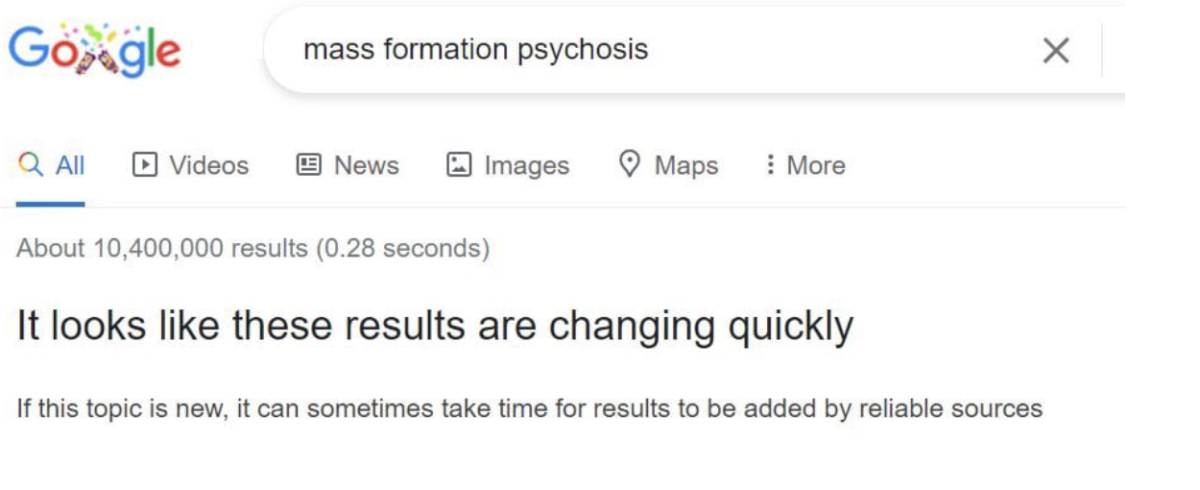
    When new code or content is being pushed to the live servers, it’s customary for web developers like myself to serve up a holding or maintenance page until the changes are completed. Google has such a holding page when its first page of algorithm driven search results don’t conform to its ideals. On December 31st of 2021, an interview with Robert Malone on Joe Rogan’s show went viral. Commenting on the public’s and government’s response to COVID-19, Dr. Malone tweaked a concept developed by Mattias Desmet called “mass formation”, inadvisedly adding “psychosis”. As a result, “mass formation psychosis” trended on Twitter and was no doubt the subject of many a Google search. But search results were withheld from the user. It looked like this.

    It looks like these results are changing quickly. If this topic is new, it can sometimes take time for results to be added by reliable sources.
    Google search results for “mass formation psychosis”, January 1, 2021

    Notice the irony of the screenshot. Google reports that there are “About 10,400,000 results”. (Because the search has already been performed by others and cached, they are retrieved, incredibly, in .28 seconds.) But instead of showing those results, Google says: “It looks like these results are changing quickly. If this topic is new, it can sometimes take time for results to be added by reliable sources.” How odd not to show the results it did have.

    Google states its reasons for the unplanned intermission. Behind the curtain, editors have judged the sources being served up algorithmically to be not “reliable”. There are gatekeepers assuming an editorial role over the information available. Danny Sullivan, Google’s Public Liaison for Search explains:

    While Google Search will always be there with the most useful results we can provide, sometimes the reliable information you’re searching for just isn’t online yet. This can be particularly true for breaking news or emerging topics, when the information that’s published first may not be the most reliable.

    Danny Sullivan, “A New Notice in Search for Rapidly Evolving Results”, The Keyword (January 25, 2021)

    The key principle cited over and over here is “reliability”. But it’s not clear that was the cardinal virtue. In haste, Google initially replenished its first page of results with a grab bag of polemical pieces from Clark County Today and YouTube (January 1, 2022 archive) while banishing links to Rogan and Malone to outer darkness. If you search for “mass formation psychosis” today, the first page features results from approved sources and fact checkers who uniformly reject the idea. It is “discredited” according to CNET, “does not exist” according to OregonLive, has “no evidence” according to a Reuters fact check, and is “unfounded” according to the AP. What you won’t find is Dr. Malone’s explanation or the Joe Rogan episode that created the dust storm in the first place. Personas non grata such as these can only be found with more specific terms by a savvy searcher.*

    Whatever the merits of Desmet’s mass formation hypothesis and his concerns about totalitarianism, there is an important lesson from this peek behind the scenes of Google’s stagecraft. All searches are being managed in this way. In this instance, users found an as-yet unscripted part of the play, but all Google searches have passed through this editorial oversight. Sources it sees in a negative light are suppressed and never see the stage. According to Oxford’s Lexico, censorship is: “The suppression or prohibition of any parts of books, films, news, etc. that are considered obscene, politically unacceptable, or a threat to security.” Google proactively promotes some search results and suppresses, that is censors, others. In our context, when you hear “censorship”, think suppression of information.

    Supporting Players Behind the Scenes

    We cannot know all the internal factors that determine a search result’s rank at Google, whether it’s due to code on the server or to company culture. It’s a closely guarded secret. Indeed, it’s quite possible no individual person knows all the quirks and signals that contribute to a page’s rank. We do know that in order to evaluate its results, Google needs a whitelist of sources it upholds as reliable, a blacklist of sources it demotes, or both. Who makes that determination? One public facing organization plays a role behind the scenes.

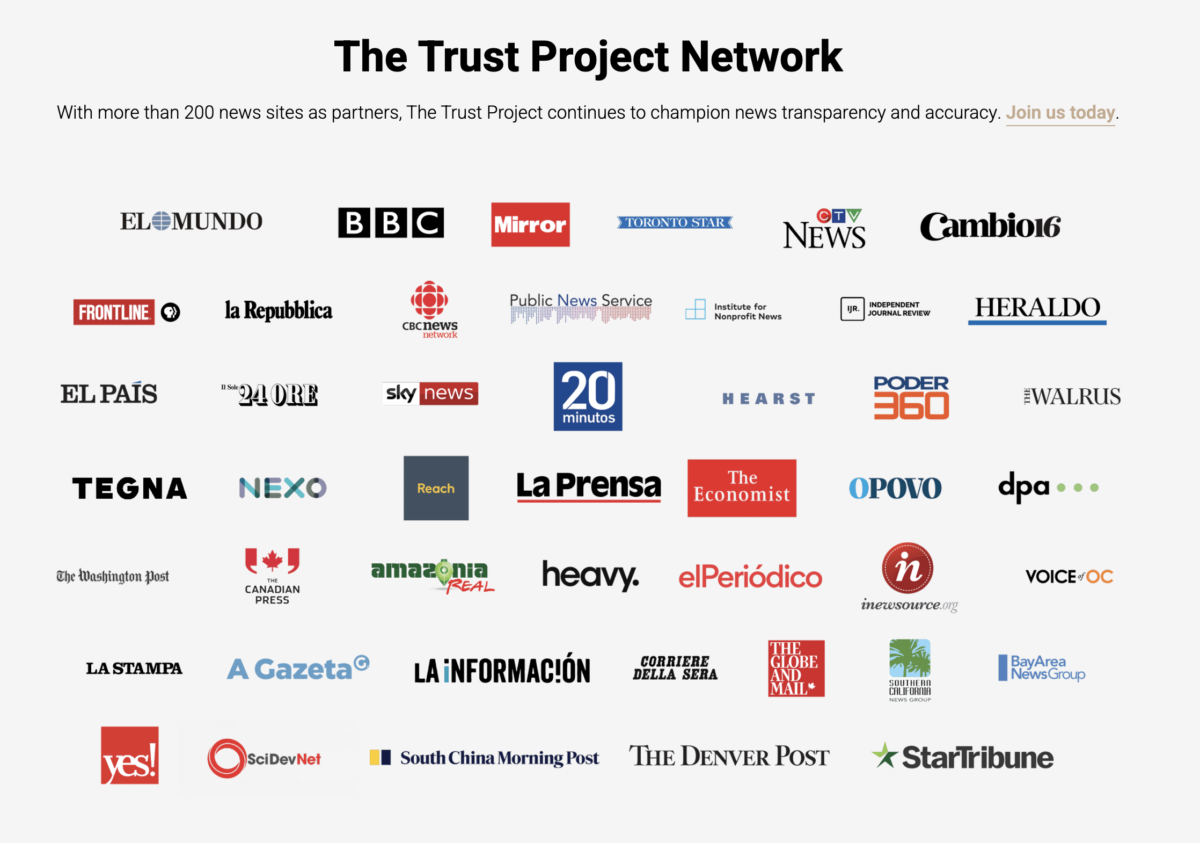
    The Trust Project was cofounded by Sally Lehrman, a journalism professor at Santa Clara University, and Richard Gingras, the head of Google News after a storied career including a long stint at Salon.com. Funding comes significantly from Craig Newmark of Craigslist fame. Lehrman, Gingras, and Newmark discussed the project’s founding at Santa Clara University in 2017. The project describes itself as motivated by a desire to restore trust in the news and it promotes eight “Trust Indicators” to this end.

    The Trust Project coalition, as featured on their website.

    The Trust Project advertises its success in playing a role in ranking results at Google, Facebook, and Bing. It’s unclear exactly how the Trust Project’s relationship with these companies works. It is clear, however, that in spite of ostensibly neutral trust factors, the news sources that are admitted entry into the coalition represent a uniformly partisan slice of the news.

    Censorship is the Status Quo

    The term censorship conjures up images of piles of burning books or dissidents locked away in the remotest reaches of Siberia. We can take heart that minority voices are not in chains in the United States. Nevertheless, we must not kid ourselves. We live under a state of highly sophisticated and ubiquitous suppression of disfavored voices. The gatekeepers like the Trust Project and Google are making judgments about who is and is not trustworthy with good intentions and in the name of noble ideals. In the interview above, Craig Newmark shares his motivation.

    In Sunday school they told us something about not bearing false witness. I’m a nerd, old school, and I’m very literal. In high school history (this was 1970), Mr. Schultzke taught us, a trustworthy press is the immune system of democracy. So you need an active press going around getting things right. … Also in Sunday school, I learned it’s better to light a candle than to curse the darkness. That’s why it’s better to mount this constructive effort, finding people a lot smarter than I am, and helping them out. Then my job is to get out of the way.

    Truth telling, a trustworthy press, and lighting a candle in the dark are unimpeachable goals. And the problem is real. Trust in journalism is abysmal. But presuming information seekers are unable to evaluate the news, taking upon oneself the mantle of the Anointed, and suppressing sources on behalf of citizens is to disempower them. Quite possibly, it is itself the leading cause of the loss in trust.

    How do we give people a greater sense of context of what’s important? I believe at core that the role of journalism is to give citizens the tools and information they need to be good citizens. That’s what we owe them and that’s what we need for our own societies. And so we need to give them that information so that when they go to the polls they have a greater sense of context.

    Richard Gringas, “Fake Facts? Rebuilding Trust in the News” (May 15, 2017) at the Markkula Center for Applied Ethics

    Finding Alternative Play-writes

    Should it be Richard Gringas and Google who decide what’s important? Who provide the context they see fit? Who prepare us for the polls? As one citizen, I would rather a search provider who is a less censorious stage manager when I’m seeking the truth of a matter. The good news is, the status quo is changing. Services like Seekr.com‘s Political Lean filter and Brave Search’s Goggles enable users to get off Broadway and break out of the implicit and inaccessible bias at Google.


    *Note: On December 5th, 2022, Google brought “continuous scrolling” to its desktop user interface. This change places more results onto the first page, but makes subsequent results harder to access. The impact for results previously beyond the first several pages remain to be seen.

  • Freedom of Conscience Is For Everyone

    Freedom of Conscience Is For Everyone

    There are virtually endless scenarios in which an employee, a small business owner, or a sole proprietor might decline to participate in a business activity or deny service as a matter of personal convictions or corporate values. In the absence of compelling reasons to punish such conscientious objection, they should be free to do so. The First Amendment guarantee of freedom of religion (i.e. freedom of conscience) is most necessary when it protects a minority with whom others strongly disagree. In the “land of the free”, the burden of proof should be on those who would use the power of government to coerce another to do their bidding. Here’s a couple dozen of the endless instances in which an individual or business should be able to make decisions in keeping with their ethical commitments. Such decisions inescapably discriminate (i.e. make a distinction or judgment) — not against vendors, customers or clients, but rather — against particular products or services that, for the provider, have an ethical dimension.

    (more…)
  • A Mess Around Here

    I was recently forced to move this site into a new content management system before I had all my ducks in a row for the move. As a result, there are broken links and rough edges strewn about. My apologies while I try to get things back in order. The truth is, recently a husband and now very recently a father, the site is a back burner priority for the time being. ~ Nate.

  • Our Kind of Skepticism

    I come lastly to a third type of intellect, in which Twofold Truth presents itself in a moderate and altogether commendable shape; in which the disparity is not so much antagonistic as complementary, and the result of its functions is not disunion and hostility so much as a broad comprehensive solidarity. For our purpose we may call intellects of this class ‘dual-sighted’ or ‘two- eyed.’ … This ‘double-sighted man’ is by no means the synonym of the nickname common in Puritan history, ‘Mr. Facing-both-ways.’ It rather implies the possession of faculties which enable the observer to see every object in the solid, substantial manner, in the full relief, and with the true perspective that pertain essentially to all double vision. It is the instinctive power and tendency to discern a specific object or a given truth not merely as it is in itself or in one of its prima facie aspects, but in its completeness as a whole and relatively to all its surroundings. We see this quality in the artist who simultaneously with the perception of an object also sees all its different phases as well as its relations to surrounding objects; or again in the general who apprehends by a single glance of his mental vision all the characteristics, bad as well as good, of a given position or military movement. So the philosophers I speak of catch every truth or doctrine, not in its simple and uniform, but in its complex biform or multiform aspect. They are men to whom every affirmation suggests, if only as a possibility, a negative; who intuitively meet every dogmatic pronouncement with an objection, just as a painter infers shadow from light. These are the men who in my judgment have rendered the best service to the progress of knowledge by their comprehensive vision, their cautious Skeptical attitude, their fearless criticism. …
    (more…)

  • Our Inescapable Pluralism

    Our Inescapable Pluralism

    The great variety of contradictory religious views is for many reason enough to conclude that there is no truth to be had in such matters. No one religion is at all likely to be closest to the truth. In his debate with Dinesh D’Souza, John Loftus argues that these inter-religious and intra-religious disagreements the gravamen of his case against Christianity, arguing that in effect they cancel each other out in virtue of the mutually exclusive nature of their claims.1 He does not see, apparently, that by such reasoning, the ageless debate between naturalists and theists is also cancelled, each position nullified. Indeed, every point of view falls prey to such a criterion. When we look within naturalism, we also find denominations and sects, a cacophony of diverse and contradictory positions on fundamental questions. It turns out, the problem of pluralism is an equal opportunity employer. Worldviews are like personalities. Each one is unique. Though there are types of personalities, just as there are broad worldview categories, none is identical. Whatever our worldview, that view must countenance the fact that many others think it mistaken. This is the problem of pluralism. The implication of this reality, however, need not be the defeat of any particular set of beliefs. Rather, the proper response is virtue. It begs modesty, a profound intellectual humility about our take on reality. And second, it should serve as a call to personal responsibility for our beliefs, and therefore to the epistemic virtues, for there is no consensus on ultimate questions that we can simply adopt by proxy.

    In adolescence, when I was for the first time really struck by the pervasiveness of irreconcilable differences between peoples, my confidence in my own beliefs was shattered irreparably. What had seemed obvious seemed less so. What I believed based upon what I thought was good reasoning was undercut by the realization that my reasoning was unpersuasive to others. And so began my journey as a truth seeker haunted by the fear that truth could not be found. Like Sisyphus, who was condemned to roll a rock up a hill only to see it roll back down, ad infinitum, I found again and again that the briefly confident conclusions of my inquiries crumbled each time with the realization that others who had traversed those same paths had concluded otherwise. This is to say, the problem of pluralism is a real and ever-present foil in my own thinking. Nonetheless, the fact of disagreement about reality is often overstated and misappropriated to prove what it does not. Here I propose what we should, and should not, take from pluralism, by which I mean the evident fact of irreconcilable differences between individuals and communities on both the details and broad strokes of reality.

    But why, exactly, is pluralism so problematic? The problem is that, to the extent that we hold mutually exclusive beliefs, it follows necessarily that very nearly all of us are wrong about many of the things we believe. This is not to minimize that which we hold in common. Graciously, substantial agreement is possible about a great deal that is required for the necessities of life. Nonetheless, our political, ethical, philosophical, historical, and religious beliefs exemplify virtually every conceivable point of view, and insofar as they reference an external world that does not indulge contradictions, many of those beliefs must be erroneous. Unfortunately, the realization that many of our beliefs are mistaken does not thereby reveal those which are true and which are false. Rather, pluralism casts suspicion on all of our controversial beliefs. The problem is exacerbated in that we must make decisions of great consequence not only for ourselves but also as families, communities, and nations. The stakes are high, and our great need is to ground our beliefs on secure foundations. But the pervasive error entailed by our pluralism persistently undermines our efforts. Our human quest for knowledge and understanding, especially in the Modern era, has largely been the effort to find solid ground amidst the quicksand, but to no avail. It seems our pluralism is inescapable. Or is it?

    Consensus by Circling

    Years ago, in conversation with some Mormon missionaries, I was presented with an argument that was part of Joseph Smith’s own departure from the received Christianity of his day. Smith was frustrated by the profusion of Christian denominations who disagreed with each other on points of doctrine large and small. He perceived these disagreements as an indication that none of them had the truth, and was at a loss until, as the story goes, the truth was restored to him by the angel Moroni. These missionaries appealed to my own frustration with the endless disagreements amongst Christians, suggesting that in Mormonism I could finally escape the squabbling and find a set of beliefs agreed upon by all. As the Church of Jesus Christ of Latter Day Saints has grown and evolved, that promised consensus is harder to find even from within, even with a “living prophet”. The main problem with their argument, however, was that these earnest missionaries did not see their own church as yet one more party to the debate about the way of things. Of course I could find more consensus by joining their party and renouncing the claims of others, just as I could by joining the Moonies or the Marxists and forswearing the rest. It is always possible to find some level of consensus by simply drawing the circle smaller. But drawing circles only underscores the persistent factiousness. And if complete consensus is demanded, that circle will have to be drawn so small as to include only oneself.

    In other words, as his creed was like no man’s else, and being well pleased that Providence had intrusted him alone, of mortals, with the treasure of a true faith, Richard Digby determined to seclude himself to the sole and constant enjoyment of his happy fortune.

    Nathaniel Hawthorne, “The Man of Adamant” (1837).

    Arguments from pluralism against religious truth proceed in the same vein. The disagreement at every level of religious affiliation is regarded as a pox on them all, without seeing that criticism as one of the dissenting parties to the discussion. If it is merely disagreement that invalidates all sides, the naturalist’s own views on God, religion, and ethics are swept away by that same tide. The irreconcilable differences between the varieties of religious expression are no more ageless or intractable than that between naturalists and theists. For at least several thousand years, humans have disagreed about whether atoms or gods are at the bottom of the universe9. Sure, the religious enterprise has failed to come to unanimous agreement about the nature of God. But the philosophical enterprise has failed no less in achieving any real consensus about fundamental reality. It is no answer to say, “but we basically agree amongst ourselves”. The problem is not Christian pluralism or religious pluralism. Pluralism challenges all. Disagreement is a defining feature of the human condition, and one cannot escape the problem of pluralism simply by choosing another circle.

    Problem Solved? Positivism.

    In the early part of the twentieth century a solution was proposed. Keying off on the more general agreement achievable when talking about things like rocks and trees and red apples, logical positivists sought agreement by banishing more ethereal subjects from the land of meaningful propositions. Whatever could not be touched, smelt, seen, heard, or deduced thereof, would not be considered a sensible subject or object of a sentence. On this proposal, the proposition “God exists” is neither true nor false. It is meaningless. “God” is not a thing we can point to or show to others in order to speak meaningful sentences about it. No doubt, if universally accepted, positivism promised to drastically diminish the range of human disagreement by constraining what was up for discussion. But in the end, positivism fell on its own sword, for its own criterion of meaning was philosophical, unfit to be weighed and measured.2 Furthermore, by so strictly limiting the explanatory options, it led to positions that were obviously wrong. For example, since conscious states are not sensible objects, feelings like pain were of necessity redefined in terms of something observable. So, behaviorists proposed that pain was not that felt sensation in the mind as we had thought, but rather the act of saying “ouch!”, or some such. Michael Egnor suggests that the final blow to the viability of behaviorism was a joke. After a night of passion, one behaviorist rolls over in bed and says to the other: “that was good for you; how was it for me?” However discomfiting the problem of pluralism, positivism presumed an artificial constraint that could not be sustained and led us down dead end trails. It was no escape.

    Problem Solved? Naturalism.

    Though shedding the hard and fast rules of positivism, naturalists continue in that tradition by constraining what can exist to that which can be a subject of the sciences, especially of physics. And who can blame them? Science rocks! By positing hypotheses, winnowing out successful hypotheses by methodical, experimental testing, only to start the process over again,scientists have achieved remarkable feats and bested all other means of winning agreement about how the world works. Thomas Nagel sympathizes with the impulse to universalize science:

    “This reductionist dream is nourished by the extraordinary success of the physical sciences, not least in their recent application to the understanding of life through molecular biology. It is natural to try to take any successful intellectual method as far as it will go.”4

    Thanks to science, we’ve sent men to the moon, and no educated person doubts the reality of elliptical planetary orbits or the double helix structure of DNA. Science is superlative at mastering matter and energy and has significantly extended the range of facts that are agreeable to us all. But here we arrive at the point of contention. Should we, because of that tremendous success, foreclose on questions science cannot answer and on hypothetical entities beyond scientific verification? The question is the answer. It is precisely the kind of question that science cannot answer about itself. To adjudicate the question, we will have to defer to reason, including the unquantifiable canons of logic, and to the history of science and ideas. We will have to appraise other supposed sources of knowledge, such as introspective awareness, moral intuition, and wisdom based on life experience. Nagel continues:

    “Yet the impulse to find an explanation of everything in physics has over the last fifty years got out of control. The concepts of physical science provide a very special, and partial, description of the world that experience reveals to us. It is the world with all subjective consciousness, sensory appearances, thought, value, purpose, and will left out; what remains is the mathematically describable order of things and events in space and time.”

    Is science sufficiently expansive to capture the full breadth of reality exhaustively? Whether it is or is not is not self-evident. Once this inevitable question is on the table, the problem of pluralism returns in full force, a multitude of positions vying for acceptance.

    In any case, the problem of pluralism rears its head even if we accept science as the sole or preeminent source of knowledge. Even within naturalism, each of the conceivable positions allowed by the data is well represented. We find strong physicalists and emergent property dualists, compatibilists and incompatibilists, determinists and libertarians, moral realists and nonrealists, ontologists and nominalists, conservatives and liberals. Human experience simply begs questions that are not answered decisively by the scientific data, and some that cannot be in virtue of its inherent limitations. Furthermore, it is impossible not to ask what the data means, to venture beyond data into synthesis and interpretation. The debate about the meaning of the surprising and strange quantum world is illustrative. No one disputes the experimental data, that photon and electron trajectories can only be determined probabilistically, and quantum mechanics is employed everyday in real life applications. Nonetheless, though the Copenhagen interpretation of this phenomenon is the orthodox one, notable naysayers persist, as well as at least half a dozen rival interpretations that are also consonant with the data. Scientific data is in one sense not unlike religious texts. It is a core set of givens that serves as a jumping-off point for a multiplicity of interpretations. It is no surprise, then, that even having given science pride of place, naturalism eludes precise definition. It lacks a universally accepted set of truths and can only be roughly characterized: epistemologically, it’s science aided by reason; ontologically, it’s elementary particles at bottom; etiologically, the story is neo-Darwinian; theologically, no God or gods exist. Beyond this central creed, disagreement runs amuck.

    Finally, naturalism as a worldview is not entitled by right to appropriate the special esteem we grant science. The scientific enterprise emerged out of a Christian culture, was forged by an eclectic mix of orthodox and heterodox “natural philosophers”, and continues to be practiced by the religious and non-religious alike. Scientific methodology is a heritage we share in common and is largely embraced by all. But while the success of science within its domain is indisputable, it is arguable whether naturalism as an all-encompassing worldview is likewise superior to its competitors in mitigating or eliminating our irreconcilable differences. Naturalists disagree amongst themselves and with others. Whatever else it may be, naturalism is not an escape from the problem of pluralism.

    The Upside of Pluralism

    As the proverb goes, iron sharpens iron. Disagreement, dissension, and debate are a refining fire, par excellence. The desire and need to control nature for our own ends and our innate desire for knowledge are powerful generators of discovery, but there is no greater engine for the refinement and discrediting of ideas than the ceaseless argument about how the world works and what it all means. I have argued that there is no escape from pluralism. We are condemned to live at ideological odds with others. But this is not to say that our arguments are stagnant, are without purpose. On the contrary, in many of our most interminable disagreements, there has been real movement, even progress.

    There is no more contentious arena than the political. It’s to be expected. Political systems effect our lives intimately for better or worse. And, as James Madison opined: “What is government itself but the greatest of all reflections on human nature?” The debate over proper governance is epic. Great thinkers have pondered and disputed it endlessly. Wars and revolutions have been fought. Contemporary political debate is a morass of intemperate wrangling. And yet, with a historical perspective, we can see a remarkable shift in the terms of debate. As Fareed Zakaria points out: “For the vast majority of the world, democracy is the sole surviving source of political legitimacy. Dictators such as Egypt’s Hosni Mubarak and Zimbabwe’s Robert Mugabe go to great effort and expense to organize national elections — which, of course, they win handily. When the enemies of democracy mouth its rhetoric and ape its ritual, you know it has won the war.”5 Moreover, some measure of both free markets and of government regulation are largely taken for granted. The raging debate resides in the center and is largely one of degree, of the appropriate measure of each. Many old arguments that seemed irreconcilable at the time were, in fact, settled. New arguments have taken their place. The moral legitimacy of American chattel slavery was so intractable that its resolution cost over 600,000 lives. A hundred years later, fully equal treatment for all was no less divisive. Graciously, the second time around it was resolved politically, though not without great personal sacrifice by civil rights activists. Today the legitimacy of slavery and legal discrimination isn’t given a second thought, and we debate instead the merits of affirmative action and reparations. The argument continues, but that is progress nonetheless.

    So be it for politics, but one might think that religion is categorically different, that with its dogma, “leaps of faith”, and eternal stakes it is immune to the refiner’s fire. Such a view requires a strange anthropology, a belief that religious people are some alien creature, somehow divested of their natural rationality and sensitivity to recalcitrant facts. The history does not bear this out. Most ancient religions are just that: relics of the past. Their followers were persuaded or otherwise motivated to discard their beliefs. Conversions to and from religions as well as the loss of religious faith altogether are commonplace. And within religious traditions, believers individually exhibit a diversity and varying confidence in their beliefs, each believer uniquely persuaded by their experiences and the evidence available to them. Religions as communities evolve as well. To name but one example, there was a time when for many Christians it was plausible to think it appropriate to persecute dissenters and wage wars over doctrinal disputes. But by exegetical debate and the weight of decisive events, such as the Thirty Years War, the consensus interpretation of scripture was reformed to such an extent that coercive indoctrination is unthinkable now. It’s no different in the philosophy of religion. To everyone’s surprise, the logical argument from evil against God was basically put to rest, and the terms of debate relocated to an inductive form of the argument. Big Bang cosmology and our increasing awareness of the necessary fine-tuning of the universe weigh heavily in the debate about God’s existence, prompting the formulation of new or revived atheistic explanations like quantum tunneling and bubble universes. Demonstrations of mind-brain correlation in neuroscience have given succor to physicalist monists and forced refinement, or at least clarification, in the substance dualist’s view. In biblical studies, the development of new methods of textual criticism provided a vast body of widely accepted facts that inform questions of authorship and dating. Indeed, even the most conservative articulations of belief in biblical inspiration have been shaped by these developments. Though we are far from the end of many such debates, religious inquiry is by no means stagnant or immune to the refining fire.

    Far from inhibiting the expansion of human understanding, in every field our inescapable pluralism is its catalyst. The quest for knowledge and understanding is a community project, a human project. Public debate and discourse is the principle means of moving it forward, kicking and screaming. And as Robert Frost would have it, “the only way around is through”. We cannot skip ahead to the resolution of the debates that so exercise us today. In any case, we cannot assume that these debates will be settled on behalf of the good and the true. Our only recourse is to participate in the debate in the hope that our best efforts to understand the world may lead to our own enlightenment and also contribute to the betterment of human understanding. Our communal quest for knowledge cannot proceed without individuals who are willing to slog through the difficult and unseemly debates that litter the path.

    The Imperatives of Pluralism

    If there is no escape from pluralism, as I think the case, what follows? As communities, the reality of pluralism warrants tolerance, freedom of speech and of conscience, and the preservation of mechanisms that facilitate the dialectic, such as journals, editorials, peer review, round tables, public debates, etcetera. These are vital. But furthermore, there is a personal imperative. Pluralism presses upon each of us an obligation to earn our beliefs by earnest inquiry, whether we welcome this onus or not. On consequential issues where there is significant disagreement, we neglect the relevant questions at our own peril. Of course, we may throw in with the majority or our own circle of friends, but to do so is a gamble. Majorities have been wrong. Authorities have been wrong. There is simply no reliable way to defer our personal responsibility to others. We can’t outsource our thinking. Again, history is instructive, and in this case fearfully so. I shudder to think that I may have opposed Galileo, Locke, Wilberforce, MLK or sided with Calhoun, with Torquemada, with Hitler. Many did, and it is naive to think we are immune from aligning ourselves against the good and the true. The Nobel Laureate Percy Bridgman described the ultimately personal nature of truth-seeking in the context of science.

    The process I want to call scientific is a process that involves the continual apprehension of meaning, the constant appraisal of significance, accompanied by the running act of checking … and of judging correctness or incorrectness. This checking and judging and accepting, that together constitute understanding, are done by me and can be done for me by no one else… They are as private as my toothache, and without them science is dead.

    Percy Bridgman, Quoted in The Age of Science, by Gerard Piel (Basic Books: 2001), p. 21.5

    The contentious scientific, political, religious, and ethical issues of our own day demand our care. If we have done our due diligence and end up on the wrong side of history, we may be forgiven. But if we sit it out, we may be the unwitting enablers of ignorance and injustice in our own day, without excuse. It is imperative that we take the pursuit of truth as a serious and personal calling.

    Secondly, it is imperative that we believe knowledge is possible. As much as the tradition of skepticism, the postmodern rejection of the possibility of knowledge is a resignation to our inescapable pluralism and just as demoralizing to our quest for truth. Postmodern analysis is deservedly renowned for its deconstruction of the self interests that incline us to believe one way or the other. Ironically, there is much Truth in this analysis. But when postmoderns prescribe relativism, they take a right when they should turn left. To suggest that because of our apparently irreconcilable differences we are all right — that it is “true” for you — is to paper over our differences and end the dialogue that promises the possibility of convergence on the truth. It would be better to infer that we are all wrong, or more accurately, partially wrong. None of us has the complete and final account of reality. This turn, by contrast, serves as an impetus for the ongoing quest. We must likewise reject the notion that our beliefs are captive to our cultural context. Culture is powerful, but not all powerful. There have always been dissenters and revolutionaries who have been able to see through the assumptions taken for granted by their countrymen. The pronounced pluralism of our own time only makes this easier because it is so obvious that our assumptions can and should be questioned.7

    It follows from our incomplete knowledge that intellectual humility is in order. Remember that pluralism entails by necessity that we are very likely wrong about some of our beliefs. We are not omniscient. Not by a long shot. “For now we see through a glass, darkly… For now we know in part.” Intellectual humility is to seriously entertain the possibility that we may be wrong, and on the flipside, to be open to the possibility that others may be right. This principle of fallibility is well put by James William McClendon, “that even one’s most cherished and tenaciously held convictions might be false and are in principle always subject to rejection, reformulation, improvement, or reformation.”On either side of every debate there are those that seem utterly incapable of second-guessing themselves. Such certain minds, who are not troubled in the least by the fact that others see things differently, escape my comprehension. But because of their intransigence, we should not follow their lead nor despair at the apparent impasses in the contemporary conversation. They too can serve as foils in our own deliberations about the merits of one view or another. And only if we ourselves are open will we be able to be corrected if we are in error. Basil Mitchell gets it exactly right with his recommendation that a spirit of self-reflection and self-criticism is apt no matter the subject.

    The main thrust of my argument has been to the effect that the charge that to accept the possibility of criticism is to rule out commitment is palpably untrue to the way our thinking really works in matters of any importance, whether religious or not. Even in the realm of the natural sciences, where the advancement of knowledge is the central concern and where the subject matter is strictly delimited, a considerable degree of tenacity is required if new theories are to be adequately tested and properly developed. Hence, established scientific systems are not abandoned in the face of problems and puzzles that are not immediately soluble. Science advances precisely by the sustained attempt to iron out these anomolies.

    Basil Mitchell, “Faith and Criticism as Interdependent” in Faith and Criticism (Oxford University Press: 1994), p.46.

    The rejection of the possibility of religious truth with which we began, merely in virtue of its contentiousness, is a case of special pleading and dismissiveness. I am sympathetic with that impulse, divisive as the history of religious differences have been. And yet, it is all too easy to dismiss religious claims in this way, with one fell swoop. It relieves one of the trouble of having to examine and weigh them. To do so, however, is to throw stones in a glass house. It is a failure to see that one’s own house is not in order. Pluralism is a challenge to us all and these imperatives are just the tip of the iceberg. The epistemic virtues are many and plot the course well. Pluralism itself settles nothing. We are left right back where we started with the need to appraise the evidence as best we can. But we arrive there, I would hope, with a profound sense of modesty about our ability to do so definitively. Thank God, the continuance of a stable and inhabitable natural world does not depend on us. And just as Camus thought Sisyphus could find joy and significance in his redundant task, we too can make the most of our inescapable pluralism.

    In the face of our disagreement, let us not abandon truth, but rather add love.

    Notes

    1 “Does the Christian God Exist?” A Debate between Dinesh D’Souza and John W. Loftus (February 9, 2010). Loftus states: “When they [the world religions and sects] criticize each other, they’re all right. What’s left, I think, is the demise of Christianity and religion as a whole.” Later, Dinesh responds to a restatement of this argument: “The presence of disagreement does not invalidate the possibility of truth.”

    2 C. A. Campbell summed up the status of Positivism nicely as it waned in influence: “In the days when the Verifiability Principle was accepted by its devotees as a secure philosophical truth, one could understand, though one might not agree with, the sweeping claim that many of the traditional problems of philosophy had been shown to be mere ‘pseudo-problems’. It was easy to see how, given the Principle’s validity, most of the leading questions which agitated our forefathers in metaphysics, in ethics, and in theology, automatically become nonsensical questions. What is perplexing, however, is that despite the pretty generally acknowledged deterioration in the Principle’s status to that of a convenient methodological postulate, the attitude to these same questions seems to have changed but little. To admit that the Verifiability Principle is not an assured truth entails the admission that a problem can no longer be dismissed as meaningless simply on the ground that it cannot be stated in a way which satisfies the Principle. Whether or not a problem is meaningless is now something that can only be decided after critical examination of the particular case on its own individual merits. But the old antipathies seem in large measure to have survived the disappearance of their logical basis. One gets the impression that for at least many thinkers with Positivist sympathies the ‘liquidation’ of a large, if unspecified, group of traditional philosophic problems is still established fact. If that impression is mistaken, well and good. One may then hope for an early recrudescence of interest in certain problems that have too long suffered the consequences of an unhappy tabu. If the impression is correct, a real service would be done to philosophy if it were plainly stated which of the traditional problems are still regarded as pseudo-problems, and what are the reasons, old or new, for passing this sentence on them. The smoke of old battles, perhaps understandably, darkens the philosophic air, to the considerable inconvenience of all concerned.”  “Is ‘Free Will’ a Pseudo-Problem?”, In Defence of Free Will (Routledge: 2004, orig. 1967), p. 17.

    3 This is, of course, a caricature of scientific method. Philosophers of science will be quick to point out that there is no strict demarcation of what is and is not appropriately scientific methodology, and here too a debate continues.

    4 Thomas Nagel, Secular Philosophy and the Religious Temperament (Oxford University Press: 2009), p. 25.

    5 Fareee Zakaria, The Future of Freedom: Illiberal Democracy at Home and Abroad (W.W. Norton: 2003), p. 13.

    6 Apropos to my defense of the salubrious effect of the competition of ideas, Piel goes on to describe what happens to beliefs earned in private when they enter the marketplace of ideas. “Upon publication, the work enters the public, social process of science. Members of the community who are interested will address it in their individual responsibility. They are a democracy of warring sovereigns. If science is not dead, they will root our frailty in the design of the experiment and error in the data. They will challenge the premises on which the work was undertaken and the meaning the author has found in it and, perhaps, argue for their own. Debate will be unsparing in the common cause of consensus.”  In, Gerard Piel, The Age of Science (Basic Books: 2001), pp. 21-2.

    7 D’Souza makes this very point: “If you happen to be born in Afghanistan, you’d be a Muslim. If you happen to be born in Tibet, you’d be a Buddhist. That’s true, but what on earth does that prove? I happen to have been born in Bombay, India, which happens to be a Hindu country. The second largest group is Muslim. Even so, by choice, I am a Christian. Just because the majority religion is one thing doesn’t make it right or wrong. By the way, what he says about Christianity or Islam is equally true about beliefs in history or science. If you are born in Oxford, England you are more likely to believe the Theory of Evolution than if you are born in Oxford, Mississippi. If you are born in New Guinea you are less likely to accept Einstein’s Theory of Relativity than if you are born in New York City. What does this say about whether Einstein’s Theory of Relatively is true? Absolutely nothing.”

    8 McClendon, Understanding Religious Conviction (University of Notre Dame Press: 1975), p. 118.

    The Epicureans and Platonists anticipated so many of the debates we continue today.

    “But you seem pretty sure that your point of view is correct. Good luck. So are the Islamists. So are the Hindus. So are the Jains. So are the Zoroastrians.” Deepak Chopra on “The Future of Faith”, Faith Under Fire (April 30, 2005) Episode 10, Season 2.

  • The Captain of My Soul

    The Captain of My Soul

    Central to the plot of Clint Eastwood’s Invictus is William Ernest Henley’s short poem of the same name. Though the role of the poem suffers some historical revisionism in the film, its role in the life of Nelson Mandela sheds light on what it truly means to be free. The film recounts the remarkable story of Mandela’s efforts at national reconciliation through his embrace of the South African rugby team, which at the time remained a symbol of Apartheid’s ethnic segregation. In 1996, when I returned for the first time to South Africa, my childhood home, some old friends shared with me how meaningful it was when Mandela appeared at Ellis Park donning the Springbok green and gold. I’m gratified that this remarkable story of reconciliation has made it to the screen, especially while Morgan Freeman is still with us. He was born to play Mandela. During Mandela’s long internment on Robben Island, Henley’s poem adorned a wall of his cell, a constant reminder that though his freedom had been taken from him, he remained “the captain of his soul“. The words of this poem, and their significance to Mandela, underscore a central point of contention in the debate about human free will. It seems to me that one problem with some arguments for compatibilism, the idea that determinism and human responsibility are compatible, is the conflating of freedom and free will. Mandela’s story is a powerful reminder that there is freedom beyond freedom. That is, it matters whether we are captains or merely observers of our souls.

    Calling upon Henley’s poem as a powerful expression of our sense of having free will, here I consider one particular line of argument: that to be free in the sense relevant to moral responsibility is just to be free from external constraint. This view, classical compatibilism, continues to assert itself in spite of so obviously missing the target.1

    (more…)
  • A Story of Natural Evil and the Suffering of Animals

    A Story of Natural Evil and the Suffering of Animals

    William Rowe’s widely discussed argument from evil imagines a fawn, alone in the woods, engulfed by a raging forest fire, suffering for days before dying. How could a good and powerful God, if he existed, allow this kind of suffering, which is immeasurable every day?

    In more recent philosophical expressions of the Problem of Evil, the argument is carefully articulated to ensure that the evil under consideration is unquestionably gratuitous. That is, while there is suffering for which the theist can posit some countervailing or soul-making purpose, there is also suffering for which it is nigh impossible to imagine any greater good being served.

    Specifically, attention has turned to natural evil, and to the suffering of animals in particular. Consider the tens of thousands of wildebeest and zebra attempting to cross the Mara River as they finish their annual migration across the Serengeti. Many are violently ripped to pieces in the attempt by basks of writhing crocodiles. It is not self-evident to me that this militates against the existence of God.1 I am awed and quickened by the spectacle. Though I naturally root for the antelope, I see tragic beauty in this contest for survival, red in tooth and claw. I’m not altogether sure that a world without peril — a world of harmless bunnies, tribbles, and parakeets, one without riptides, sandstorms, cliffs and fires — would better bespeak a great and beneficent creator. Indeed, I wonder whether a world whose magnificence is due in part to its being as wild and untamed as ours is not itself a justification for the peril and pain entailed therein.

    When I say that I am not sure, that is the truth. I am by no means unsympathetic to the suffering of animals. My heart is rent when I watch PETA’s documentaries exposing our oftentimes callous and cruel treatment of animals bred for human consumption. It is egregious to kick a dog, to string up a cat. Furthermore, we have the biblical vision of heaven which portrays a time and place when the lion lies down with the lamb, implying perhaps that the current, ravenous state of nature is not the way it’s supposed to be.

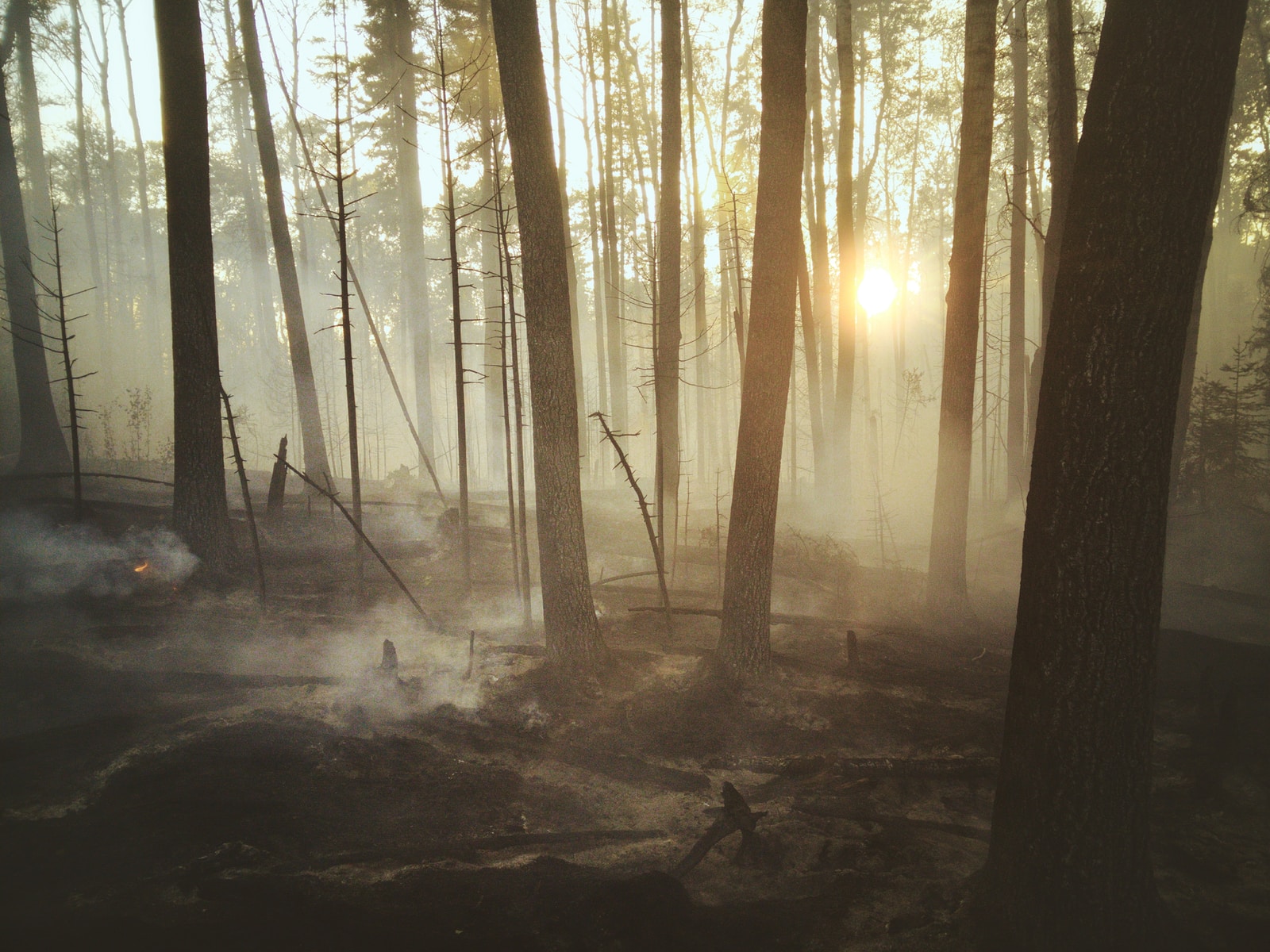
    Considering the abundance of animal suffering, it has always struck me as a bit unfortunate that the examples offered by Rowe, Tooley, and others in these arguments are usually abstract, when they needn’t be.2 So, as I continue to reflect on what we should infer from a natural world that is as violent as it is breathtakingly beautiful, I offer the following contribution. It is a riveting account from the journal of a close friend, Dace Starkweather, who experienced the very real, fiery devastation of Pike National Forest3. He bore witness to the woodland creatures and free range cattle that suffered there. I don’t think anyone has ever questioned whether Rowe’s example is paralleled in the real world, but this vivid, real-life account makes the question of apparently pointless natural evil all the more poignant.


    Dace writes:

    I believe I left off describing my sleepless night and smoke filled lungs. Obviously I couldn’t tell this at the time, but the fires surrounding me covered a fifteen mile radius. At some point, I did drift back into a sleep. I remember hearing the familiar sound of the engine of my Toyota pickup returning to the ranch. My truck had survived! I was glad, but I was too exhausted to get up and check it out or even open my eyes. If it was running… that’s all I needed to know. By the way, as an aside, Jeb told me later that when he fetched my truck, the ground was scorched all around it, but that there was a small triangle where my truck was parked that was left untouched. When Jeb popped the hood (which you have to do in order to start it) he said it was the most crazy thing — mice were everywhere. On the engine block, down behind the wheel wells. These homeless field mice were looking for any object to take refuge in to avoid the heat waves of the fire, to avoid being burned.

    I had overslept on my shift and the sun was just coming up. I got up and felt like I had the taste of campfire in my mouth and a grimy layer of dirt and ash was still covering me from head to toe. I had slept in my clothes. As I looked around, everything was peaceful, including this blanket of white smoke that just hung a few feet above the ground across the entire valley. I saw my truck and was relieved. Then I was momentarily startled as I noticed some homeless guy asleep inside of it. It was Jeb. We both looked pretty rugged and were covered in ash. I let him sleep. After  completing a round on the buildings — putting out various ground fires and digging some trenches — I went and saddled up my four-year-old, Casper. We rode the perimeter of the property and up into the woods. It was one of the most bizarre things I have ever seen. The best way to explain it is to recall the opening scene in Gladiator. They had just finished the battle and Maximus is walking back through the battle grounds that are still smoldering, small fires burning everywhere. It was like that. The valley was incredibly green and vibrant, but fifty yards up into the trees it turned into a lunar moonscape. The pine trees were black totem poles and the ground was a dusty ash grey and white. There was no vegetation, just scarred boulders and black gravel. Casper and I walked past hundreds of logs, stumps and trees that were on fire, still smoking or reduced to heaps of soft red coals.

    Then I realized that they were not running away because their hooves and paws were singed.

    I saw an unusual amount of wildlife. And nothing ran away. I saw deer, bear, elk. They all looked shocked. They just stood there. Then I realized that they were not running away because their hooves and paws were singed. I ran into the yearling bear cub and my close proximity forced him to move. He walked away on his elbows. The pads of his paws were swollen and bleeding. It tugged at me emotionally, but barely. I was in the same daze as they were as I tried to assess this charred world. Two things came to mind: a sense of awesome power… and of an inescapable ugliness.

    I decided that at this point, the need of the hour was safety first… that perhaps I didn’t want to try to carry a weapon and live ammo in a hot and ashy forest while on the back of a horse. We rode out south and almost as soon as you cross the property line, the trees turn black. Again, the ground was a soft layer of gray-white ash. It truly looked like what I would expect the surface of the moon to be. There were also sink holes where the fire still burned hot. These holes were formed by the root systems that burned down under the ground. They looked like half-crazed starfish imprints. It was all negative shape, each imprint taking the exact shape of its root system. It was an image I would never have been able to conjure up without seeing it first hand.

    I found a buck down by wildcat creek that didn’t make it — of all the fleet footed animals that you think would survive — but perhaps this one turned right when he should have hung a left and ended up running back into the flames. I have heard that animals run back to what they have always considered their home and safety. A famous fire outside of Chicago years ago at a large horse farm is perhaps instructive: the barn was on fire and so they opened all the stall doors to free the horses. In all the panic and confusion, the horses actually ran back into the burning barn to seek safety in their stalls. I have no idea how you would calculate the wildlife lost to the fire. Some of the guys just found a bear last week.

    Shortly after finding the buck, Lee radioed me and told us that he had found several dead cows in a draw behind Salt Lick 7. Why we are all wired in such a way that we are so curious and feel the need to witness this gruesome scene for ourselves is beyond me. I think guys are maybe just built that way. Nonetheless, we made a beeline for what we now have deemed “Dead Cow Draw.”

    We made a beeline for what we now have deemed “Dead Cow Draw”. … There was a cow hunkered down in this creek bottom trying to stay wet and cool, while her calf was nuzzling up along side of her. And that’s how they were found. Like statues.

    Next to the concentration camps I saw in ’95, it is the most disturbing scene I have ever laid eyes on. Eleven cows and ten calves dead. The haunting part is that they possessed a quality that almost made them look as if they were frozen in mid-stride. There was a cow hunkered down in this creek bottom trying to stay wet and cool, while her calf was nuzzling up along side of her. And that’s how they were found. Like statues. Everything was extremely black in this draw … signifying that the fire had come through at a voraciously hot and fast pace. Talking with fire experts later has led me to believe that these cows did not die because of fire or smoke, but rather because of oxygen depravation, that is, suffocation. It has been found that if a draw is steep enough and the fire is hot enough coming over the top of a ridge, it will suck all the oxygen right out of the floor.

    The stench invoked my gag reflex, repeatedly. Sorry, but i’m just trying to give you the experience. Lee yelled down to us from up above that he had found a live cow. We all jumped back in the saddle and rode up to where he was. Sure enough, there was a hideous looking cow laying amidst ash and rock. Her body was emaciated, her skeletal frame showing through, and her head was swollen. The white markings she had on her face were a tarnished yellow from the severity of the fire’s heat. She looked miserable. In an act of compassion I got down from my horse and started to move towards this pathetic creature. Instantly she jumped up and rammed me, literally tossing me into the air. I felt like a rag doll. This act of aggression took place in a second or two. We were all stunned to a point of stillness. Then I told the fellas to chase her down. If she was willing to travel, then we were certainly going to bring her in. But she collapsed about fifty yards up the draw. She had used all her energy in that moment of protecting herself from a perceived threat, very unusual behavior for a cow. It made me realize how rattled she was. She was in some half-crazed state. We left her knowing that we would have to put her down.

    Notes

    1 To really see this spectacle in all its fierce glory, see Africa: The Serengeti, especially if it appears at your local IMAX theater, as I saw it.

    2 Plantinga also has a habit of referring to Dostoevsky’s famous — but fictional — description of the misdeeds of the Turks and Circassians when addressing the problem of moral evil.

    3 The Hayman Fire Disaster destroyed 138,000 acres and 133 homes in twenty days in June of 2002.

  • One Less God

    An increasingly popular rhetorical meme in debates about God, it seems, is the idea that the theist is really on the same trajectory as the atheist. After all, the theist has also rejected every god, save one. It was perhaps Stephen Henry Roberts who revived this charge: “I contend that we are both atheists. I just believe in one fewer god than you do. When you understand why you dismiss all the other possible gods, you will understand why I dismiss yours.” Richard Dawkins echoes: “We are all atheists about most of the gods that humanity has believed in. Some of us just go one god further.” Or, in Christopher Hitchens’ words: “Everyone in this room is an atheist. Everyone can name a god in which they do not believe.” Interestingly, the charge dates back to at least AD 155, when devotees of the Roman pantheon of gods leveled a similar accusation. At the trial of Polycarp, the Martyrdom of Polycarp records that the crowd yelled: “This is the teacher of atheism, the father of the Christians, the enemy of our gods, who teaches so many to turn from the worship of the gods and not to sacrifice.”1

    (more…)
  • New Design and Features

    I hope you’re enjoying Afterall.net’s new look. In addition, I’ve recently added a few new features that I hope make the site even more useful. First, the entire site now features RSS feeds. You can subscribe to any section or category, or just to the front page to be sure to get our featured posts. Look for the RSS (it’s subtle) in the banner above as you browse the site. Secondly, I’ve added a print view for longer articles, like those found in Paper TrailsClippings, and Book Reflections. This feature is helpful not only for printing but also if you happen to prefer reading black text on white instead of on our lovely ochre. Third, we’ve added the Google Translator to the left. So if you’ve got a friend whose “english not so good”, feel free to point them to the site anyway. I’m only able to judge the Spanish translations, and though not perfect, they’re not bad either. Finally, you can also use the define link at the left to easily look up some of the more esoteric philosophical terms you’ll find here. If you have any other suggestions, please let me know.