A while back Bradley Monton invited his friend and colleague, Nicole Hassoun, to post an incipient sketch of an argument against the existence or goodness of the Christian God. The basic thrust of her concern is as follows: "Perhaps I have the story wrong, … but it seems to me that several things are true of love. First, if I love someone, I cannot believe that that person deserves eternal suffering. … Second, when someone I love is hurt, that hurts me. I could not be perfectly happy if someone I loved was suffering for eternity. I cannot even conceive of such a thing. But then it seems there is a problem. For, I could be saved while someone I love is not saved. Then I could be perfectly happy in heaven while a person I love is burning in hell. But if I love someone, I cannot even think this is possible. So I should not, if I love, believe in this kind of Christianity. It could not be right unless my love would disappear at the gates of heaven (or some such) and why, I wonder, would that be? Wouldn´t it be better if heaven had my love in it? Wouldn’t I be happier in love?" My own cursory, and incipient, response follows…
A while back Bradley Monton invited his friend and colleague, Nicole Hassoun, to post an incipient sketch of an argument against the existence or goodness of the Christian God. The basic thrust of her concern is as follows: "Perhaps I have the story wrong, … but it seems to me that several things are true of love. First, if I love someone, I cannot believe that that person deserves eternal suffering. … Second, when someone I love is hurt, that hurts me. I could not be perfectly happy if someone I loved was suffering for eternity. I cannot even conceive of such a thing. But then it seems there is a problem. For, I could be saved while someone I love is not saved. Then I could be perfectly happy in heaven while a person I love is burning in hell. But if I love someone, I cannot even think this is possible. So I should not, if I love, believe in this kind of Christianity. It could not be right unless my love would disappear at the gates of heaven (or some such) and why, I wonder, would that be? Wouldn´t it be better if heaven had my love in it? Wouldn’t I be happier in love?" My own cursory, and incipient, response follows…
Go
Despite the wide variation in the circumstances surrounding close calls
with death and in the types of persons undergoing them, it remains true
that there b a striking similarity among the accounts of the
experiences themselves. In fact the similarities among various reports
are so great that one can easily pick out about fifteen separate
elements which recur again and again in the mass of narrative that I
have collected. On the basis of these points of likeness, let me now
construe a brief, theoretically "ideal" or "complete" experience which
embodies all of the common elements, in the order in which it is
typical for them to occur. ¶ A man is dying and, as he reaches the
point of greatest physical distress, he hears himself pronounced dead
by his doctor. He begins to hear an uncomfortable noise, a low ringing
or buzzing, and at the same time feels himself moving very rapidly
through a long dark tunnel. After this, he suddenly finds himself
outside of his own physical body, but still in the immediate physical
environment, and he sees his own body from a distance, as though he is
a spectator. He watches the resuscitation attempt from this unusual
vantage point and is in a state of emotional upheaval. ¶ After a while,
he collects himself and becomes more accustomed to his odd condition.
He notices that he still has a "body," but one of a very different
nature and with very different powers from the physical body he has
left behind. Soon other things begin to happen. Others come to meet and
to help him. He glimpses the spirits of relatives and friends who have
already died, and a loving, warm spirit of a kind he has never
encountered before — a being of light — appears before him. This being
asks him a question, nonverbally, to make him evaluate his life and
helps him along by showing him a panoramic, instantaneous playback of
the major events of his life. At some point he finds himself
approaching some sort of barrier or border, apparently representing the
limit between earthly life and the next life. Yet, he finds that he
must go back to the earth, that the time for his death has not yet
come. At this point he resists, for by now he is taken up with his
experiences.
It has been remarked, that the moral precepts of Christianity are highly valuable, not only when viewed in reference to their primary and direct object, the direction and guidance of the movements of the inner and outer man, the regulation of the temper and conduct, the dispositions and actions, but also when considered in their subsidiary and indirect references, particularly in their bearing on the evidence of the Divine origin of that system of revelation of which they form so important a part. That bearing is manifold. Let us look at it in its various phases. Were a book, consisting partly of doctrinal statements and partly of moral precepts, claiming a Divine origin, put into our hands; and were we to find on perusal the moral part of it fantastic and trifling, inconsistent with the principles of man’s constitution, unsuitable to the circumstances in which he is placed, and incompatible with the great laws of justice and benevolence, we should enter on the examination of the evidence appealed to, in support of its high pretensions, under the influence of a strong and justifiable suspicion. …
"Recent Advances in Metaphysics", Lowe's keynote address, about his four-category ontology, at the International Conference on Formal Ontology in Information systems (October 17-19, 2001, Ogunquit, Maine).
There is a widespread assumption amongst non-philosophers, which is shared by a good many practising philosophers too, that ‘progress’ is never really made in philosophy, and above all in metaphysics. In this respect, philosophy is often compared, for the most part unfavourably, with the empirical sciences, and especially the natural sciences, such as physics, chemistry and biology. Sometimes, philosophy is defended on the grounds that to deplore the lack of ‘progress’ in it is to misconceive its central aim, which is to challenge and criticise received ideas and assumptions rather than to advance positive theses. But this defence itself is liable to be attacked by the practitioners of other disciplines as unwarranted special pleading on the part of philosophers, whose comparative lack of expertise in other disciplines, it will be said, ill-equips them to play the role of all-purpose intellectual critic. It is sometimes even urged that philosophy is now ‘dead’, the relic of a pre-scientific age whose useful functions, such as they were, have been taken over at last by genuine sciences. What were once ‘philosophical’ questions have now been transmuted, allegedly, into questions for more specialised modes of scientific inquiry, with their own distinctive methodological principles and theoretical foundations.
In The Heavenly City of the Eighteenth-Century Philosophers Carl Becker argues that histories written in the eighteenth century were designed with one purpose in mind — to discredit Christianity. Enlightenment philosophers knew they were engaged in a cultural battle for people’s hearts and minds. In Becker’s words, they felt themselves “engaged in a life-and-death struggle with Christian philosophy and the infamous things that support it — superstition, intolerance, tyranny.” Their historical accounts were intended as weapons in the struggle. ¶ These histories would generally open with the Greco-Roman world, praised as a golden age of reason; move to the Middle Ages, denounced as a dreary period of ignorance and oppression,and end with the contemporary age, the Enlightenment, heralded as a revival of ancient wisdom and rationality. Clearly, this was no attempt at objective, fact-base history.
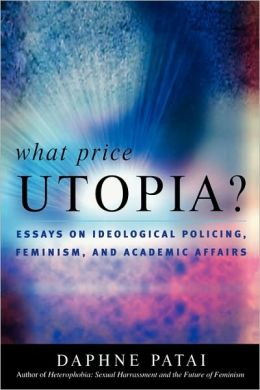
Feminists have often called Women’s Studies the “academic arm of the women’s movement.” But Daphne Patai and Noretta Koertge charge that the attempt to make Women’s Studies serve a political agenda has led to deeply problematic results: dubious scholarship, pedagogical practices that resemble indoctrination more than education, and the alienation of countless potential supporters. In this new and expanded edition of their controversial 1994 book, the authors update their analysis of what’s gone wrong with Women’s Studies programs. Original chapters feature interviews with professors, students, and staffers who invested much time and effort in Women’s Studies, and new chapters look primarily at documents recently generated from within Women’s Studies itself. Through critiques of actual program mission statements, course descriptions, newsletters, and e-mail lists devoted to feminist pedagogy and Women’s Studies, and, not least, the writings of well-known feminist scholars, Patai and Koertge provide a detailed and devastating examination of the routine practices found in feminist teaching and research. ~ Publisher’s Description
In Of Liberty and Necessity James A. Harris presents the first comprehensive account of the free will problem in eighteenth-century British philosophy. Harris proposes new interpretations of the positions of familiar figures such as Locke, Hume, Edwards, and Reid. He also gives careful attention to writers such as William King, Samuel Clarke, Anthony Collins, Lord Kames, James Beattie, David Hartley, Joseph Priestley, and Dugald Stewart, who, while well-known in the eighteenth century, have since been largely ignored by historians of philosophy. Through detailed textual analysis, and by making precise use of a variety of different contexts, Harris elucidates the contribution that each of these writers makes to the eighteenth-century discussion of the will and its freedom.