AI Empowers Creativity and Creates Work
Nathan JacobsonMany are anxious about the rise of generative software marketed as “artificial intelligence”: software such as ChatGPT for text, Midjourney for images, Sora for video, and Suno for music. Some have raised concerns about a loss of truth and creativity, or about whole categories of gainful employment being decimated. To be sure, we’ve all seen our feeds populated by deceptive images and videos and lazy AI slop. There are bound to be many other harmful uses of generative software. Some jobs will be lost, others gained. Nevertheless, I’d like to make a case, from the perspective of a creator and graphic designer, that the anxiety about generative AI is largely unwarranted.
Tools
To be human is to use tools. We have been inventing, sharpening, and depending on tools of all kinds as far back as we can trace. The ancients used sticks and stones and animal-hair brushes to paint the cave walls red. Today we use Photoshop and Illustrator to color the glass pixels on our screens. In 1990, I was screen printing t-shirts and stippling with pen and ink in art class when I first began doing page layout on the Macintosh LC using Aldus Pagemaker and scanned clip art — my first journey from analog to digital. A decade later, for my first short film, I used Photoshop, Illustrator, Final Cut Pro, Soundtrack, and low resolution GIFs and JPEGs scoured from the burgeoning internet. This year, for Discovery Institute’s COSM Technology Summit, I created the graphics and shorts using Photoshop, Illustrator, and Final Cut Pro, as before. Two relatively new generative AI tools joined the toolset: Midjourney provided the clips, and Suno the theme song.
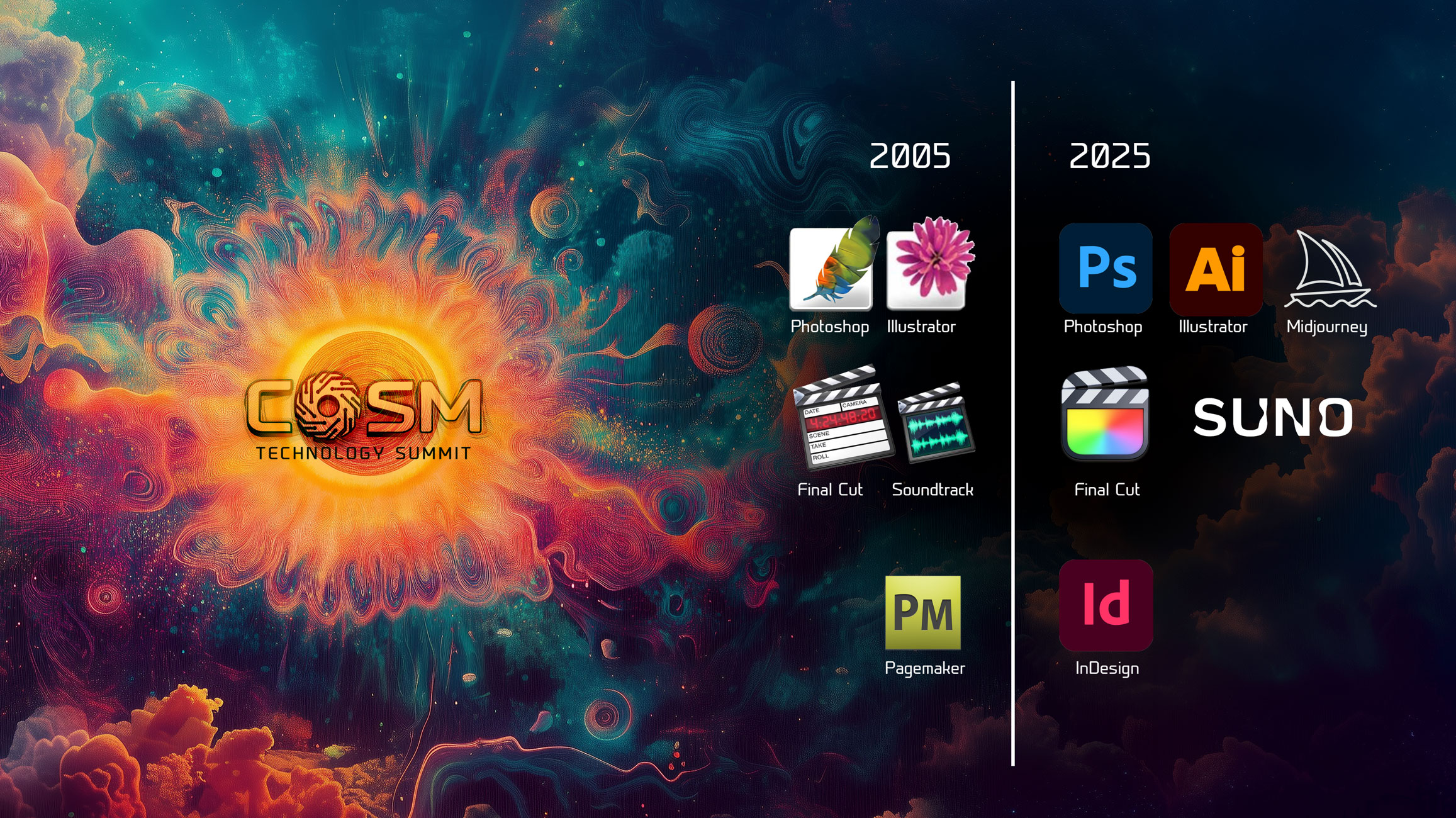
Working as a designer for over three decades, I am struck by the continuity of tools over time. I’m also reminded of how much work these tools eliminate from the creative process. Typesetting in InDesign requires the tiniest fraction of the labor needed for a letterpress. Kerning, leading, tracking, and variably sized type are a breeze and require no lead for spacing or chopped cherry trees for woodblock letters. Each software advance has facilitated new styles and greater efficiency while empowering me to do more than I ever could have with the previous toolset. Nevertheless, creating these moving images required hundreds of hours and thousands of ideas and decisions.
In view of the long history of technologies that have facilitated the visual arts, what is the magnitude of change these latest tools represent? Is the development of generative software of the same gravity as the invention of the printing press, of the camera, of computer graphics? Or is it more akin to the introduction of layers in Photoshop or non-linear editing in filmmaking? When the camera was invented, depicting people and events became available at the click of a button. Artists understandably worried about the widespread availability of something only they had been able to do, with great training and effort. Art did change irrevocably. Digital photography and desktop printing ushered in further efficiencies, saving the hours spent smelling the vinegary acetic acid in the dark room. Now that my child can produce a neo-impressionist self-portrait or place themselves in a Himalayan scene with just a prompt, what does it portend for the creative arts?
I reckon generative AI is more akin to a significant step forward for creatives than an earth shattering leap into a whole new world. Neural networks, machine learning, large language models, image segmentation algorithms, and generative diffusion are software innovations that are just the latest milestones on a long march of hardware breakthroughs and software algorithms.
For example, ever since its debut, Photoshop has been filled with mathematical marvels that have enabled the tweaking and morphing of images. It’s hard for math mortals like myself to comprehend the calculations that are involved in inverting, cropping, filtering, and layering an image. These formulas have been hard-won by an enormous team of image processing engineers and mathematicians that have enabled digital artists to rearrange, blend, and stylize their work for decades. Indeed, filters like watercolor, fresco, and ink scratches appeared very early. And way back in 1996, Adobe introduced Actions in Photoshop 4.0, an automation tool that let users create a sequence of commands and play them back on other layers and images. These scripts enabled creators to more easily stylize their artworks as vintage, embossed, graffiti and a thousand other styles. A large third-party market of Actions developed and digital artists have relied on these recipes ever since.
Ingredients
Graphic designers and creators of all sorts have always relied on many ingredients and processes that they themselves did not create. Graphic designers use software, fonts, printers, and stock images, not to mention the design precedents of other artists that guide their work. For some projects I have created my own typefaces, sometimes I’ve created the source imagery myself, like spray painting graffiti onto cardstock for Free Science. I mixed thick coffee and wine and poured it onto a green screen to simulate blood for a film project. Some logos I’ve designed started as sketches with a pen or pencil. But even in such cases I rely on many ingredients and tools that I did not create. It’s like Leonard E. Read’s famous essay, “I, Pencil”. No one person knows how to make a pencil. The constitutive parts are sourced from a crowd of contributors, from lumberjacks, steelworkers, and graphite miners to machinists and importers.
I think of generative AI as a vast new source of creative material, providing ingredients that I can use to make art. As with the parts of a pencil, software generated ingredients are a human product. Note well the literal definition of artificial: something made or produced by humans rather than occurring naturally. Everything about generative artificial intelligence is human in origin. The enormous data centers, the hydroelectric dams, the code innovations, the training data, the output evaluation, and the prompting all originate in a human mind endowed with creativity and reasoning. In the case of generative AI, that training data represents the sum of unfathomable hours of human creativity: petabytes of prose, poetry, painting, and song. So-called AI is not an accomplishment of machines or some emergent new intelligence. It is, rather, the extension of countless hours of human labor and logic. It is not a first cause nor a final cause. It is an efficient means for humans to create mashups of thousands of years of human creativity. Try as we might to endow our machines with their own vision, agency, and creativity, there’s no reason yet to think we can pass on these incredible gifts that we possess.
It is humbling to remember how much we each depend upon the work of others to do our own work. It is also ennobling to remember with gratitude the unique gifts with which we are endowed. Granted, the extent to which a creator can call his or her art their own will depend upon how much of it is a product of their own work, versus how much is a product of the labor of others. A child who traces a giraffe and colors within the lines has added little. A cartoonist who only redraws Calvin & Hobbes or a memester who only adds a quip to characters generated in the style of Studio Ghibli adds little more. A graphic designer who uses stock imagery or fonts shares credit with the photographer or artist who created those elements.
It is counter-intuitive, but using software generated images, videos, and sound allows the creator to put more of themselves into their work, not less. Depending upon stock images, clips, and tracks can be a very limiting and tiresome endeavor, often requiring hours of searching through stock providers for suitable source material. Being able to generate custom creative assets with a prompt enables the artist to shape their ingredients with the subject and style that is in keeping with their creative vision.
Though it is now possible to generate a derivative piece of artwork with just a prompt, projects still require an idea, thoughtful prompts, and much in the way of curating and baking these ingredients into a whole.
Stylization
Every time I open Midjourney, it’s like visiting an art museum. The community gallery is full of the unexpected and introduces me to new styles and ideas. My own generations are a mix of my favorite styles: lithograph, risograph, Neo-impressionist, ink sketch, Norman Rockwell, etcetera. The art is of course wholly derived from the humans who created these styles in the first place, but it is nonetheless a joy to behold.
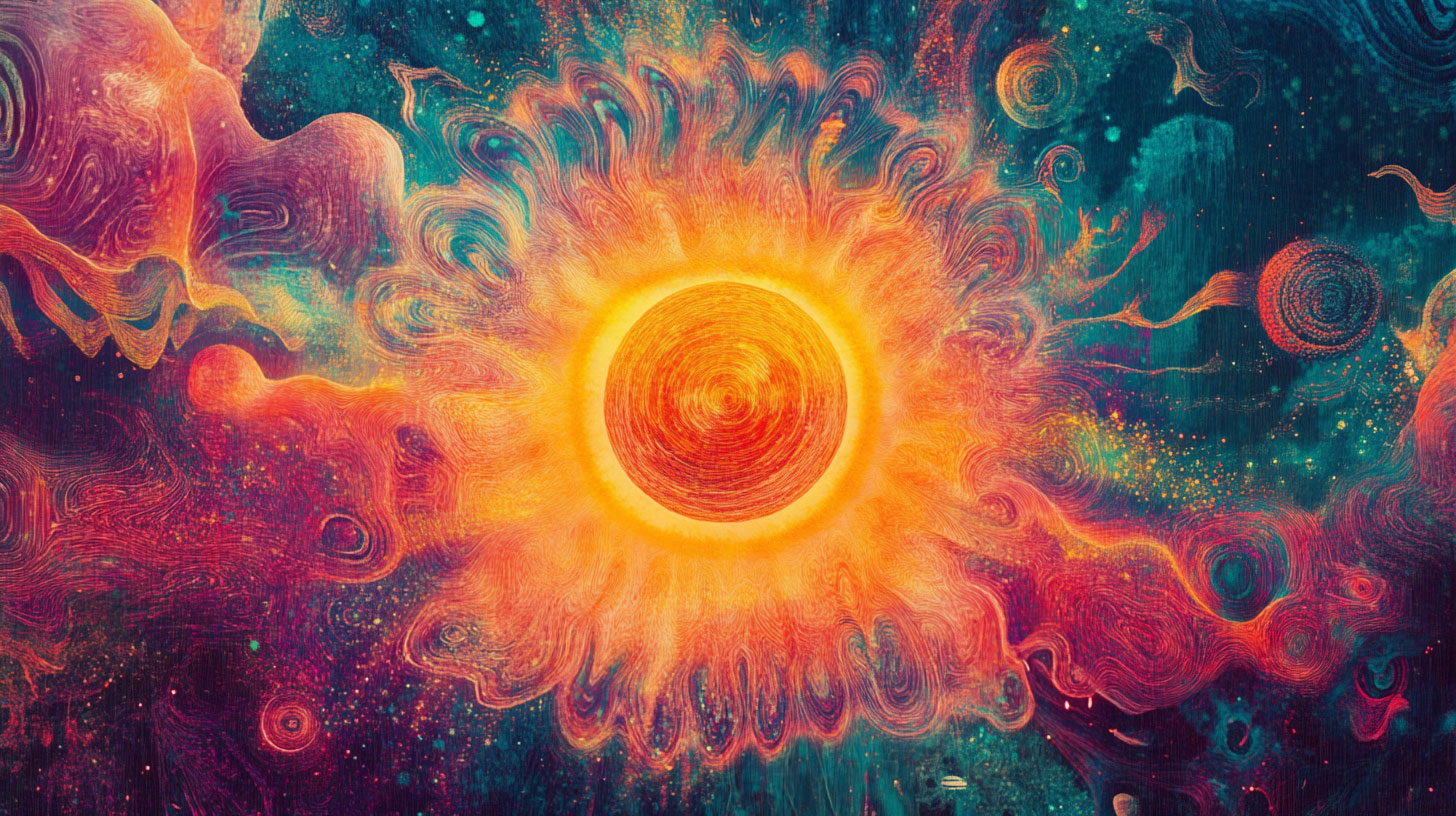
One of the most empowering features of these generative systems is the ability to find and work within a style. For COSM I proposed the theme “vibe shift”. This initial idea got me thinking about “good vibrations”, and then about the sixties and seventies. We were headed to sunny Scottsdale, Arizona. So, a simple prompt came to mind: “disco, psychedelic sun”. This image below, generated by Midjourney, among many others, captivated me. It served as the seed for thousands of images to come — many unusable, but some pure gold.
Somewhere, many years ago, I had seen a liquid light show and the beautiful, organic shapes created by viscous oils and colorful liquids swishing around on top of an overhead projector. That provided the inspiration for a series of accompanying speaker profile images that were, well, groovy. Swirls of liquid colors frame their heads, the reference image lubricating the transfer of complementary colors.
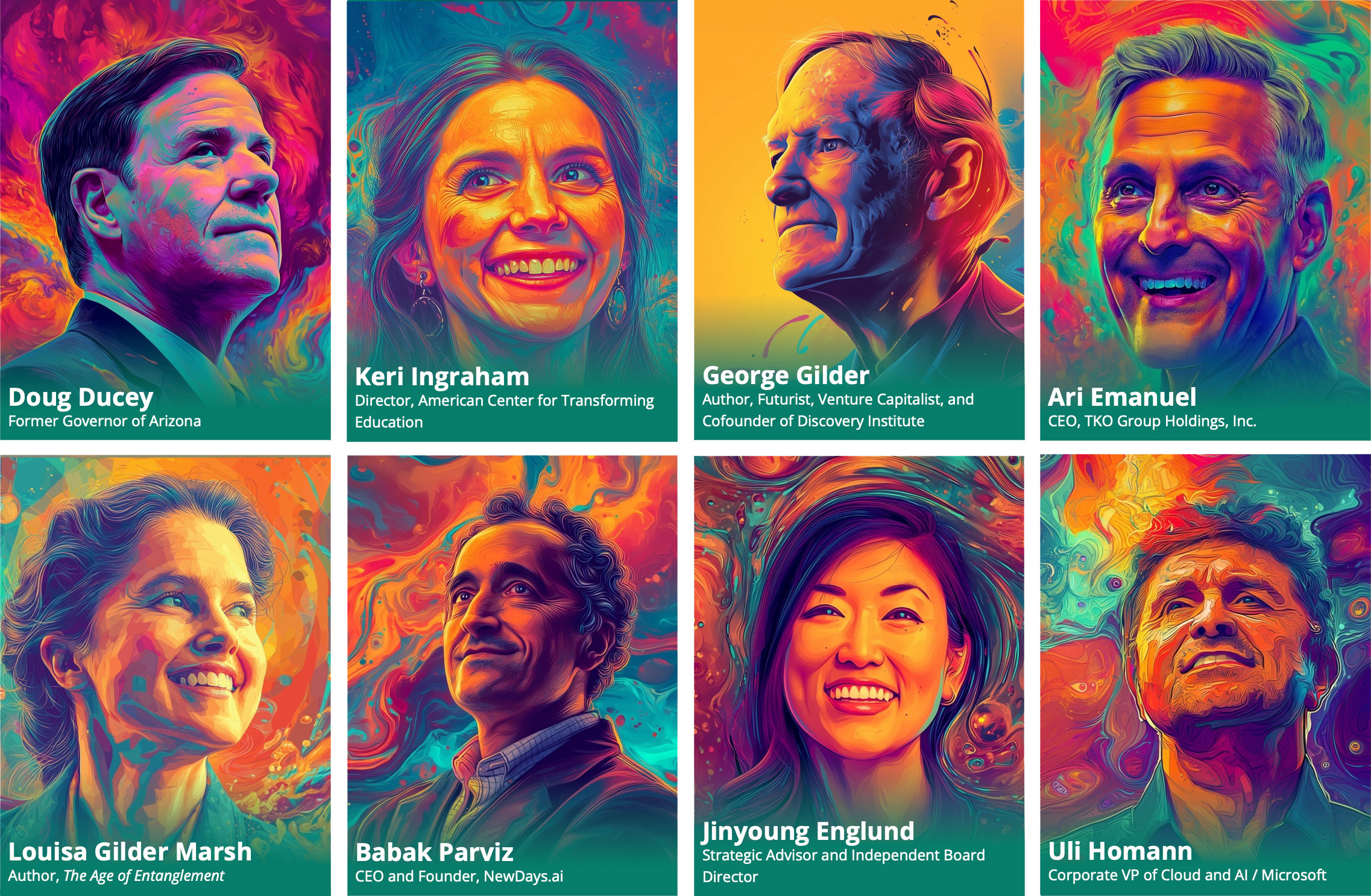
At each step there was a back and forth between the generative tool and my own ideas. Headshots have always been a challenge for designers. Speakers, board members, staff, fellows, and other participants — whoever they may be — submit a mess of images of varying quality, tone, and resolution. Short of flying everyone in for a photo shoot, an attractive and cohesive page of profile shots is elusive. I would upscale, lighten, and clear distracting backgrounds. Photoshop’s programmers tried to help, offering a series of various tools over the years to distinguish the edges of loose strands of hair. It was never perfect, even with hours of manually masking each strand, zoomed in all the way to show each individual pixel. Though the accuracy of the likenesses varies in these portraits, this new ability to stylize each one in varying poses opens up a creative solution I’ve craved. It remains very time consuming.
Fortuitously, Midjourney introduced image to video in the middle of this process, bringing these illustrations to life.
With generative tools at our disposal, our art will represent every combination of original and derivative input in the years to come. Thus it has always been. Artists and creators who use these tools the most creatively and competently will be the ones who create the most outstanding work. The product will continue to be more than the sum total of its many parts — something new, creative, and human.
The Work Is Infinite
If you’re like me, your life and your job require prioritization. There are always neglected projects and emails buried in my inbox for lack of time. At home, my honey-do list is bottomless, my basement remodel unfinished. At work, the more websites and videos and logos I develop, the more opportunities arise to rework and apply them. Work is not in limited supply. There is always and forever more to do. The Sabbath is a gift to rest from one’s work, because we are finite and the work is not.
Those who worry about AI eliminating jobs have failed to learn the lesson of history, which has seen countless jobs eliminated time and again, and each time more jobs created. In the Palouse farm country where I used to live, museums showcase old combines that required thirty horses and dozens of men to operate. Today, that same job takes a few farmers to drive the combine and grain carts. And yet, the agricultural industry struggles not with too many, but with too few laborers.
I fully expect that by equipping a much broader swath of society with tools that fill in gaps in their skill set and save time, the amount of work available will increase. A friend who is a novelist is turning his story into a movie with software generated audiovisuals. It’s a movie that would not have existed otherwise. Another friend used generative tools to bring the Harry Potter universe alive for his children’s birthday party. He wrote code and programmed a Raspberry Pi to create an interactive game, his area of expertise. For the narration he employed AI, customizing messages to each of his children’s friends in the voices of Rowling’s beloved characters. Both of these creators put a lot of themselves into these experiences. New tools made it possible for them to realize their vision.
I, for one, am enthused about the possibilities that lie ahead with the new tools and ingredients coming online.