Who among evangelicals can stand up to the great secular or naturalistic or atheistic scholars on their own terms of scholarship? Who among evangelical scholars is quoted as a normative source by the greatest secular authorities on history or philosophy or psychology or sociology or politics? Does the evangelical mode of thinking have the slightest chance of becoming the dominant mode in the great universities of Europe and America that stamp our entire civilization with their spirit and ideas?… For the sake of greater effectiveness in witnessing to Jesus Christ Himself, as well as for their own sakes, evangelicals cannot afford to keep on living on the periphery of responsible intellectual existence.
If the matter were considered open to question, there would be plenty of reason to doubt that natural selection has the vast creative powers Darwinists attribute to it. What we actually know from scientific investigation is information like the following: artificial selection can produce diverse varieties of dogs and monstrous fruitfly variants; the relative frequency of dark and light peppered moths in a population was observed to vary as the trees became lighter and darker; differential survival causes bacterial populations to develop resistance to antibiotics; living forms share a common biochemical basis and genetic code; new body plans tend to appear in the fossil record fully formed with no record of the transitional intermediates that should connect them to presumed ancestors; and finally, the prevailing pattern of fossil species is stasis, meaning that observed evolutionary change is limited and directionless.
In this I tend to share the concern of Richard Lewontin, who wrote in the New York Review of Books: "Who am I to believe about quantum physics if not Steven Weinberg, or about the solar system if not Carl Sagan?" What worries me is that they may believe what Dawkins and [Edward O.] Wilson tell them about evolution. What worries me is that so many physicists and geologists seem to think that the peppered moth or finch beak observations illustrate a mighty creative force that produced moths and birds in the first place. I hope that they apply more rigorous standards for evaluating evidence when they are estimating the age of the earth.
Go
The creation-evolution controversy is one of those subjects that has become standardized in the press. I sometimes have the impression that journalists just click on a "bash creationism" macro in their word processors and sit back while the printer pours out a string of cliches: the Catholic Church persecuted Galileo, the Scopes trial in 1925 should have settled this matter, the Bible is not a scientific textbook, scientists agree that "evolution has occurred," mainstream religious leaders say that God and evolution are compatible, and the country will fall into ruin if evolution is not emphasized in the schools. Even the feeble witticisms are standardized, as columnists either exploit the irony that "creationism is evolving" or speculate that the next creationist move will be to declare the earth flat, while the editorial cartoonists caricature opponents of Darwinism as apemen. The journalistic macro learned what little it knows about the subject from polemics by scientific materialists like Isaac Asimov, Carl Sagan, Richard Dawkins and Stephen Jay Gould, who are accepted by journalists as impartial authorities because they speak in the name of "science." So the macro defines creationists as Bible thumpers who either are ignorant of the scientific evidence that contradicts their position or choose to disregard it. From that starting point it is inconceivable that creationists could have any rational arguments to make, and you can cite just about anything you like, from fossils to finch beaks to pesticide resistance, to make them look like people blind to facts. There is no need to try to understand the dissenting point of view because according to the macro all doubts about evolution are irrational by definition.
It is not surprising that in a country where the vast majority of citizens believe in God, it is controversial to require that the public schools teach as fact (or as implicit in the very definition of “science”) that God played no discernible part in the creation of plants, animals and human beings. It is also not surprising that many citizens, unpersuaded by official reassurances that “science and religion are separate realms,” suspect that a religious or antireligious ideology lies behind the enormous importance science educators attach to persuading young people that evolution is their creator.
Go
Are we to infer from this that the world was made by a Creator?
Certainly not, if we are to adhere to the cannons of valid scientific
inference. There is no reason whatever why the universe should not have
begun spontaneously, except that it seems odd that it should do so; but
there is no law of nature to the effect that things which seem odd to
us must not happen. To infer a Creator is to infer a cause, and causal
inferences are only admissible in science when they proceed from
observed causal laws. Creation out of nothing is an occurrence which
has not been observed. There is, therefore, no better reason to suppose
that the world was caused by a Creator than to suppose that it was
uncaused; either equally contradicts the causal laws that we can
observe.
No circle is reserved for man alone… He is, according to the diagram, shut up in the little circle entitled ‘Mammals,’ with thirty-four hundred and ninety-nine other species of mammals…. What shall we say of the intelligence, not to say religion, of those who are so particular to distinguish between fishes and reptiles and birds, but put a man with an immortal soul in the same circle with the wolf, the hyena, and the skunk? What must be the impression made upon children by such a degradation of man?
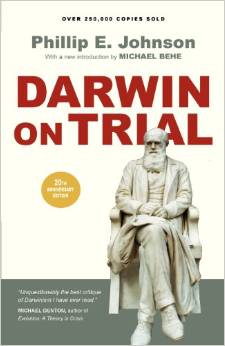
In his own era, Darwin’s most formidable opponents were fossil experts, not clergymen. Even today, according to the author, the fossil record, far from conclusive, does not support the presumed existence of intermediate links between species. A law teacher at UC-Berkeley,
Johnson deems unpersuasive the alleged proofs for Darwin’s assertion that natural selection can produce new species. He also argues that recent molecular studies of DNA fail to confirm the existence of common ancestors for different species. Doubting the smooth line of transitional steps between apes and humans sketched by neo-Darwinists, he cites evidence for “rapid branching,” i.e., mysterious leaps which presumably produced the human mind and spirit from animal materials. This evidence, to Johnson, suggests that “the putative hominid species” may not have contained our ancestors after all. This cogent, succinct inquiry cuts like a knife through neo-Darwinist assumptions. ~ Publishers Weekly