The word Sabbath, means REST, that is, cessation from labour, but the stupid Blue Laws of Connecticut make a labour of rest, for they oblige a person to sit still from sunrise to sunset on a Sabbath day, which is hard work. Fanaticism made those laws, and hyprocrisy pretends to reverence them, for where such laws prevail hypocrisy will prevail also. ¶ One of those laws says, “No person shall run on a Sabbath-day, nor walk in his garden, nor elsewhere, but reverently to and from meeting.” These fanatical hypocrites forgot that God dwells not in temples made with hands, and that the earth is full of his glory. One of the finest scenes and subjects of religious contemplation is to walk into the woods and fields, and survey the works of the God of the Creation. The wide expanse of heaven, the earth covered with verdure, the lofty forest, the waving corn, the magnificent roll of mighty rivers, and the murmuring melody of the cheerful brooks, are scenes that inspire the mind with gratitude and delight. But this the gloomy Calvinist of Connecticut gratitude and delight. But this the gloomy Calvinist of Connecticut must not behold on a Sabbath-day. Entombed within the walls of his dwelling, he shuts from his view the Temple of Creation. The sun shines no joy to him. The gladdening voice of nature calls on him in vain. He is deaf, dumb, and blind to every thing around that God has made. Such is the Sabbath-day of Connecticut. ¶ From whence could come this miserable notion of devotion? It comes from the gloominess of the Calvinistic creed. If men love darkness rather than light, because their works are evil, the ulcerated mind of a Calvinist, who sees God only in terror, and sits brooding over the scenes of hell and damnation, can have no joy in beholding the glories of the Creation. Nothing in that mighty and wondrous system accords with his principles or his devotion. He sees nothing there that tells him that God created millions on purpose to be damned, and that the children of a span long are born to burn forever in hell. The Creation preaches a different doctrine to this. We there see that the care and goodness of God is extended impartially over all the creatures he has made. The worm of the earth shares his protection equally with the elephant of the desert. The grass that springs beneath our feet grows by his bounty as well as the cedars of Lebanon. Every thing in the Creation reproaches the Calvinist with unjust ideas of God, and disowns the hardness and ingratitude of his principles. Therefore he shuns the sight of them on a Sabbath-day.
In religion, as in every thing else, perfection consists in simplicity. The Christian religion of Gods within Gods, like wheels within wheels, is like a complicated machine that never goes right, and every projector in the art of Christianity is trying to mend it. It is its defects that have caused such a number and variety of tinkers to be hammering at it, and still it goes wrong. In the visible world no time-keeper can go equally true with the sun; and in like manner, no complicated religion can be equally true with the pure and unmixed religion of Deism.
I heard the bells on Christmas Day
Their old, familiar carols play,
And wild and sweet
The words repeat
Of peace on earth, good-will to men!
And thought how, as the day had come,
The belfries of all Christendom
Had rolled along
The unbroken song
Of peace on earth, good-will to men!
Till ringing, singing on its way,
The world revolved from night to day,
A voice, a chime,
A chant sublime
Of peace on earth, good-will to men!
Then from each black, accursed mouth
The cannon thundered in the South,
And with the sound
The carols drowned
Of peace on earth, good-will to men!
It was as if an earthquake rent
The hearth-stones of a continent,
And made forlorn
The households born
Of peace on earth, good-will to men!
And in despair I bowed my head;
“There is no peace on earth,” I said;
“For hate is strong,
And mocks the song
Of peace on earth, good-will to men!”
Then pealed the bells more loud and deep:
“God is not dead, nor doth He sleep;
The Wrong shall fail,
The Right prevail,
With peace on earth, good-will to men.”
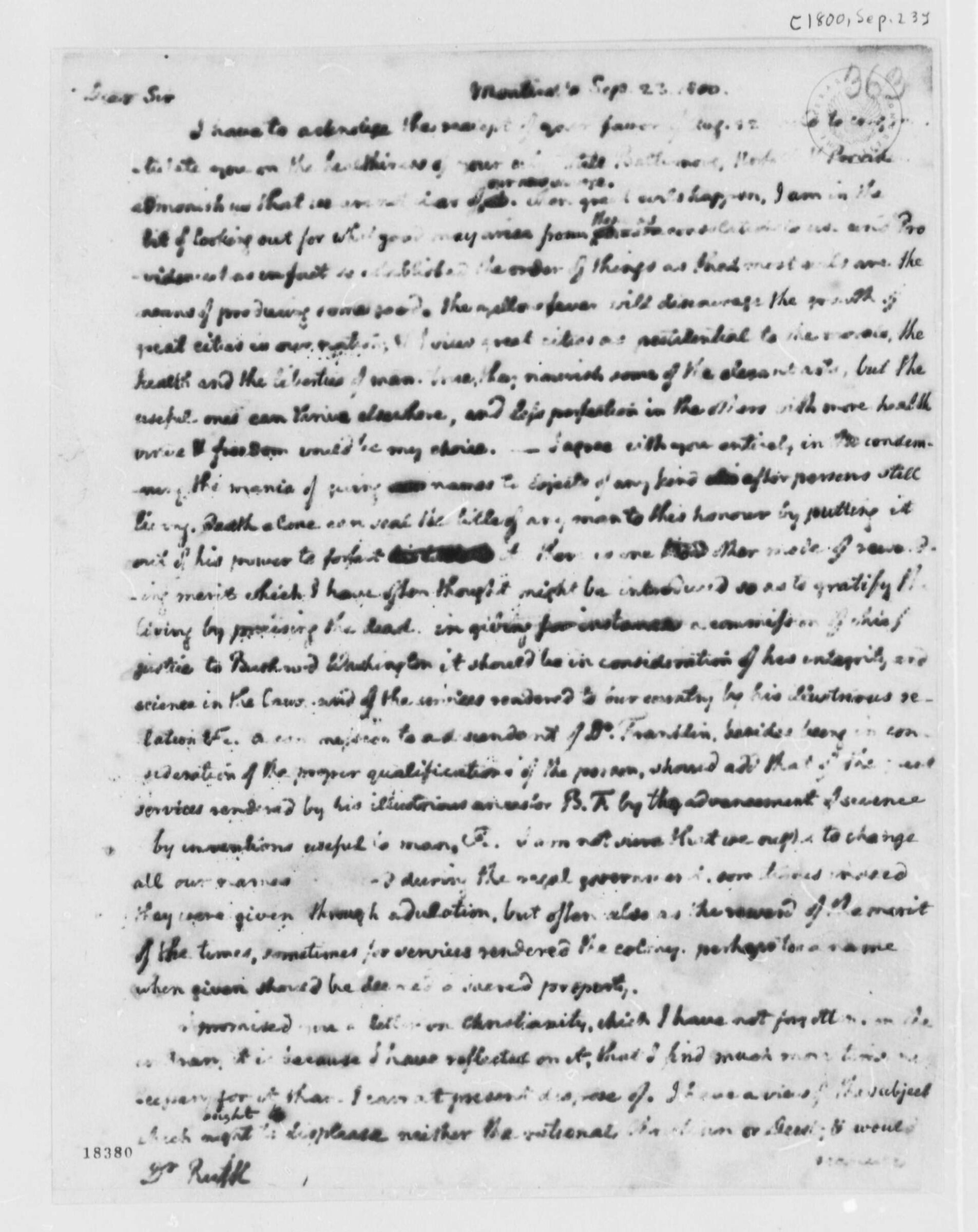
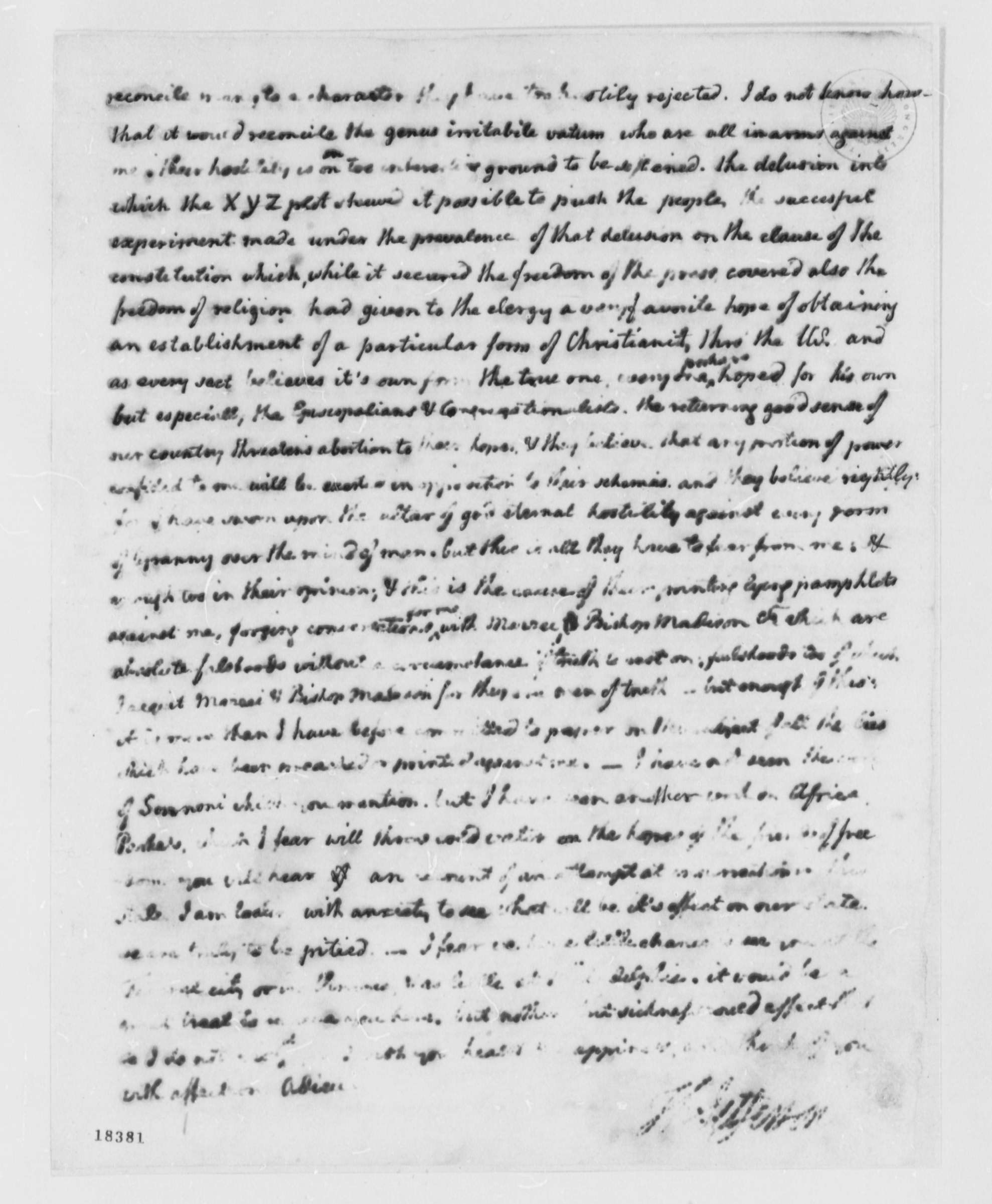
I promised you a letter on Christianity, which I have not forgotten. On the contrary, it is because I have reflected on it, that I find much more time necessary for it than I can at present dispose of. I have a view of the subject which ought to displease neither the rational Christian nor Deists, and would reconcile many to a character they have too hastily rejected. I do not know that it would reconcile the genus irritabile vatum who are all in arms against me. Their hostility is on too interesting ground to be softened. The delusion into which the X. Y. Z. plot shewed it possible to push the people; the successful experiment made under the prevalence of that delusion on the clause of the constitution, which, while it secured the freedom of the press, covered also the freedom of religion, had given to the clergy a very favorite hope of obtaining an establishment of a particular form of Christianity thro’ the U. S.; and as every sect believes its own form the true one, every one perhaps hoped for his own, but especially the Episcopalians and Congregationalists. The returning good sense of our country threatens abortion to their hopes, and they believe that any portion of power confided to me, will be exerted in opposition to their schemes. And they believe rightly; for I have sworn upon the altar of god, eternal hostility against every form of tyranny over the mind of man. But this is all they have to fear from me: and enough too in their opinion, and this is the cause of their printing lying pamphlets against me, forging conversations for me with Mazzei, Bishop Madison, et al, which are absolute falsehoods without a circumstance of truth to rest on; falsehoods, too, of which I acquit Mazzei and Bishop Madison, for they are men of truth.
I have sworn upon the altar of god, eternal hostility against every form of tyranny over the mind of man.
As the Government of the United States of America is not, in any sense, founded on the Christian religion; as it has in itself no character of enmity against the laws, religion, or tranquility, of Mussulmen; and, as the said States never have entered into any war, or act of hostility against any Mahometan nation, it is declared by the parties, that no pretext arising from religious opinions, shall ever produce an interruption of the harmony existing between the two countries.
All obstructions to the execution of the laws, all combinations and associations, under whatever plausible character, with the real design to direct, control, counteract, or awe the regular deliberation and action of the constituted authorities, are … of fatal tendency. … However combinations or associations of the above description may now and then answer popular ends, they are likely, in the course of time and things, to become potent engines, by which cunning, ambitious, and unprincipled men will be enabled to subvert the power of the people and to usurp for themselves the reins of government, destroying afterwards the very engines which have lifted them to unjust dominion. …
Go
There is no subject more interesting to every man than the subject of government. His security, be he rich or poor, and, in a great measure, his prosperity, are connected therewith; it is therefore his interest as well as his duty, to make himself acquainted with its principles, and what the practise ought to be.
Thomas Paine, from Paris, Dissertation on First Principles of Government (7 July 1795).
Go
He that would make his own liberty secure must guard even his enemy from oppression; for if he violates his duty he establishes a precedent that will reach to himself.
I went to the Garden of Love, And saw what I never had seen: A Chapel was built in the midst, Where I used to play on the green.
And the gates of this Chapel were shut, And ‘Thou shalt not’ writ over the door; So I turn’d to the Garden of Love, That so many sweet flowers bore.
And I saw it was filled with graves, And tomb-stones where flowers should be: And Priests in black gowns, were walking their rounds, And binding with briars, my joys & desires.
I believe in one God, and no more; and I hope for happiness beyond this life. I believe in the equality of man; and I believe that religious duties consist in doing justice, loving mercy, and endeavouring to make our fellow-creatures happy. But, lest it should be supposed that I believe many other things in addition to these, I shall, in the progress of this work, declare the things I do not believe, and my reasons for not believing them. I do not believe in the creed professed by the Jewish Church, by the Roman Church, by the Greek Church, by the Turkish Church, by the Protestant Church, nor by any church that I know of. My own mind is my own church. All national institutions of churches, whether Jewish, Christian or Turkish, appear to me no other than human inventions, set up to terrify and enslave mankind, and monopolize power and profit. I do not mean by this declaration to condemn those who believe otherwise; they have the same right to their belief as I have to mine. But it is necessary to the happiness of man that he be mentally faithful to himself. Infidelity does not consist in believing, or in disbelieving; it consists in professing to believe what he does not believe.